
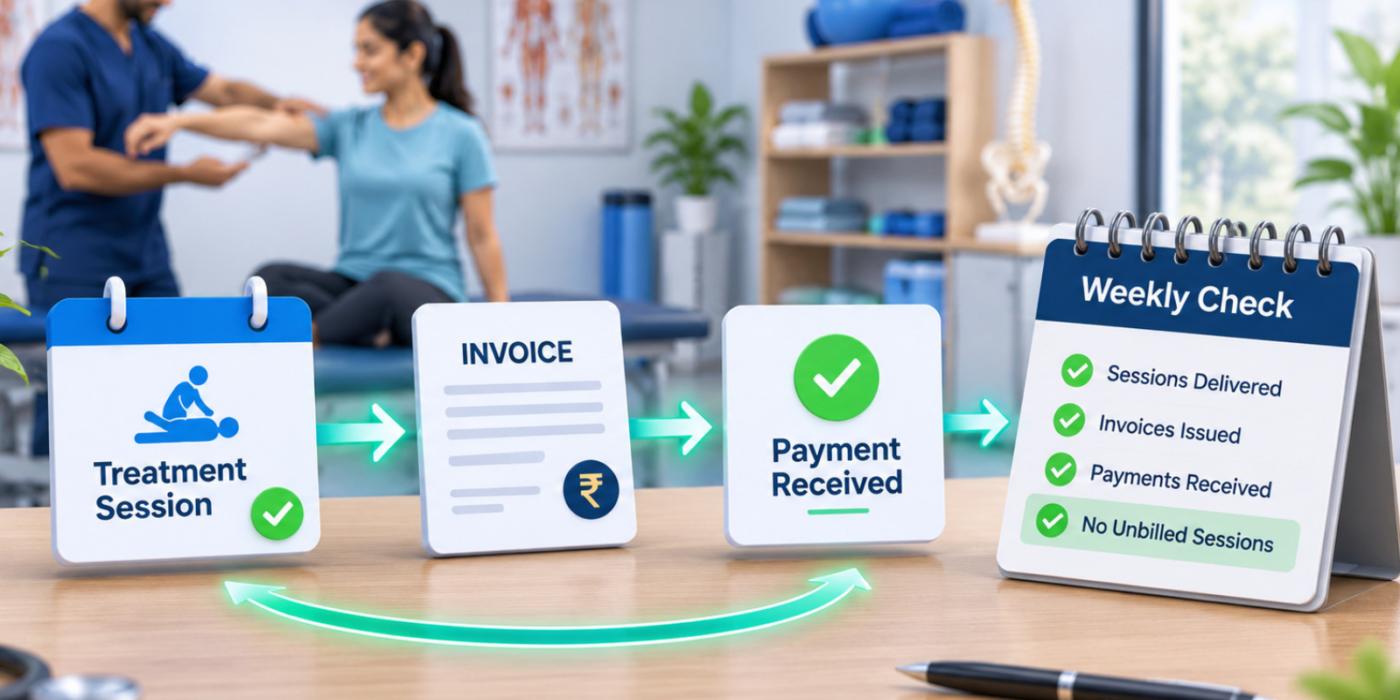
Short answer: An unbilled session is a treatment you delivered that never became an invoice or a recorded payment. It’s one of the quietest ways a physiotherapy clinic loses money, because nothing looks wrong: the patient was seen, the notes were written, and the diary shows the visit as done. The fix is a simple check that compares sessions delivered with payments recorded, run every week, plus a habit of recording payment at the visit.
Key takeaways
- Unbilled sessions usually come from small gaps in routine, not from carelessness: a patient who “will pay next time”, a package that ran past its last paid session, a front desk that was busy.
- You can’t spot them if sessions, invoices and payments live in different places. You need to compare the three.
- A weekly check takes about ten minutes and catches most of the leak while patients still remember the visit.
- Free sessions should be deliberate and recorded as free, so they don’t look like mistakes later.
- Linking each payment to a treatment plan and a visit number makes gaps easy to see.
What is an unbilled session?
It’s work done but not charged for. The therapist treated the patient. The session was logged, or at least it happened. But there’s no invoice for it, or no payment against it, and nobody noticed.
It’s different from an overdue invoice. With an overdue invoice you know you’re owed money, and you can chase it. With an unbilled session, you don’t know. There’s nothing to chase because the paperwork that would remind you doesn’t exist.
On our billing page we describe this directly: sessions get delivered but never invoiced, and overdue payments pile up. Following up becomes a manual, uncomfortable process that nobody wants to own. That second problem is the more visible one. The first is the one that goes unseen.
How do sessions end up unbilled?
Almost nobody skips billing on purpose. It happens through ordinary situations. Here are the common ones.
- “I’ll pay next time.” The patient has no cash or their phone isn’t working, so you let it go. Next time, a different issue comes up and the earlier session is forgotten.
- A package that ran over. A patient pays for ten sessions. They attend twelve. The last two are never billed, because the plan was marked as paid.
- A busy day. Three patients arrive at once, notes get written but receipts don’t, and by evening the details have blurred.
- Different people, different habits. One therapist records payments at the visit. Another leaves it to the desk. The desk assumes the therapist has done it.
- Follow-ups and quick checks. A short review “just to see how the knee is” turns into a session of treatment, but it’s never charged.
- Home visits and extras. Travel time, a special material, or an add-on service gets done but not added to the invoice.
- Rescheduled appointments. A session moves from Tuesday to Thursday, and the billing event gets lost in the move.
- Verbal discounts. You agree to a reduced rate in conversation, and the difference is never written down, so no one knows whether it was a discount or an error.
None of these are dramatic. Each one is small. Added up across a month, they matter.
How much can unbilled sessions actually cost?
That depends on your clinic, so here’s an illustration with made-up numbers. It isn’t a Phyjio result or a benchmark. It just shows how the maths works.
| Assumption | Example figure |
|---|---|
| Average fee per session | ₹800 |
| Unbilled sessions per month | 6 |
| Missed income per month | ₹4,800 (6 × ₹800) |
| Missed income per year | ₹57,600 (₹4,800 × 12) |
Six sessions in a month sounds small, and in a busy clinic it can be. But it’s the kind of leak that never shows up in a monthly total, because the total only counts what was recorded. Replace the example with your own fee and your own estimate. If you honestly don’t know how many sessions slip through, the weekly check below will tell you after a few weeks.
Why is it so hard to see?
To spot an unbilled session, you have to compare two lists: what was delivered and what was billed. In many clinics those two lists live in different places. Sessions are in a diary or a notebook. Payments are in a spreadsheet, a phone’s messages or a receipt book. Nobody is responsible for lining them up.
That’s why the same gap shows up in clinics of every size. Our post on billing problems in Indian physiotherapy clinics covers some of the wider causes, and our page on replacing spreadsheets and paper files shows how scattered tools lead to missed payments and unbilled sessions.
How do you find unbilled sessions? A weekly check
You need three things: a list of sessions delivered, a list of payments or invoices, and ten minutes. Here’s the routine, adapted from the weekly billing check-up on our billing page.
- List the sessions you delivered this week. Use your diary or session records. Include follow-ups, home visits and free reviews.
- List the receipts or invoices for the same week. Include payments recorded and invoices issued.
- Match them. For each session, look for a payment or an invoice. Ticks where they match. Gaps where they don’t.
- Sort the gaps. For each unmatched session, decide which of these it is: (a) unbilled by mistake, (b) already covered by a package payment, (c) a deliberate free service, (d) an unpaid invoice that’s just late.
- Fix them. Create the missing invoice, record the payment, or mark the session as free and note why.
- Follow up while it’s fresh. A patient who is asked about a session two days later remembers it. One who is asked two months later may not.
- Note the cause. If three gaps this week were “paid next time”, you know where to tighten your routine.
It sounds like a lot until you do it. With a short list of sessions and a short list of payments, it’s around ten minutes. And the first week is always the longest, because you’re also catching up on older gaps.
How do you handle packages without losing track?
Packages are where unbilled sessions hide most easily. A patient pays for a course up front, and then the sessions happen over weeks. You need two numbers side by side: sessions paid for and sessions delivered.
Phyjio’s treatment plans track completed and remaining sessions. The treatment plan list shows Session Frequency, Status, Start Date and Total Days, plus Remaining and Completed columns. If a plan was billed as a package of ten, and the Completed count has reached eleven, that’s a flag. Either the plan has been extended and needs a new invoice, or a session was added that wasn’t paid for.
The same idea works without software. Keep a “paid” and a “done” count for each package, and compare them at the weekly check. Our guide on treatment plan management for physiotherapy shows how to keep that kind of record.
What about free sessions?
Sometimes you’ll choose not to charge. A first consultation, a quick review, a goodwill session for a long-term patient. That’s your decision. The key is to make it deliberate and visible.
If a free session is just left blank, it looks the same as a missed invoice. Three months later, you can’t tell the difference. Record it as free, with a short note on why. Phyjio’s reports give a breakdown of consultations, sessions and free services, according to the reports page, which means free work is counted separately instead of disappearing.
It also helps to decide your policy ahead of time. For example: “First consultation free; reviews within two weeks of discharge are free; anything else is billed.” Then you don’t have to decide each time.
How do you make recording payment part of the visit?
The most effective fix is to record the payment (or the invoice) before the patient leaves, not at the end of the day. A few ways to build the habit:
- Put the payment step in the routine. After the session notes, the next action is recording the payment. Make it the same order every time.
- One person owns it. Either the therapist or the front desk, but not “whoever’s free”. If both are involved, be clear who does what.
- Link the payment to the visit. Phyjio’s Receipts page has columns for Receipt number, Patient Name, Receipt Date, Amount and Receipt Type, plus Treatment Plan Number and Visit Number. When a receipt carries the plan and visit number, a gap between sessions delivered and money recorded is much easier to spot. It also makes patient questions simple to answer, because you can show which visit a payment covered.
- Handle “pay next time” properly. If someone can’t pay, create the invoice for that session anyway and mark it as unpaid. That way it appears as an outstanding balance, which is visible, not as a missing session, which isn’t.
That last point matters most. An unpaid invoice is easy to see and chase. An unrecorded session is invisible.
What does a good billing set-up look like?
A set-up that makes unbilled sessions hard to miss has a few features:
- Sessions, invoices and payments sit in one system. Phyjio’s billing page says sessions are logged in the same system as invoices and the calendar, so sessions you deliver can be invoiced rather than slipping through.
- Invoices work per session or per package. Phyjio can generate either, and tracks payment status across paid, partial and overdue.
- An outstanding figure is always visible. The dashboard and the appointments page both show an Outstanding figure.
- Reports compare expected and received. Phyjio’s revenue report shows expected versus received amounts, so you can see the gap between what is owed and what has come in.
Note the limit of what a report can show. A revenue report works from the data you’ve entered. If a session was never invoiced, it’s not in the “expected” figure either. So the weekly match against your diary is still the safety net. Reports tell you about the invoices you have, and the check tells you about the ones you don’t.
A simple monthly review
Once the weekly habit is in place, add a short monthly look:
- Count sessions delivered in the month.
- Count sessions invoiced or paid, and sessions marked free.
- Check the three numbers add up. If delivered doesn’t equal invoiced plus free, find the difference.
- Look at your outstanding balances. Who has carried a balance for more than a month?
- Write down one process change for next month.
If you want a regular routine for the wider numbers, our posts on tracking clinic financial health in five minutes a day and the physiotherapy clinic KPI dashboard are good companions. For payment follow-up, see physiotherapy clinic payment tracking and our page on tracking payments in a physio clinic.
Getting the invoice itself right
Part of avoiding unbilled work is making invoices quick to produce. If creating one takes five minutes of fiddling, it gets put off. A clear, consistent format helps, and our guide to the physiotherapy bill format sets out what to include on every invoice. If you’re also thinking about how sessions are recorded clinically, session and progress tracking shows how Phyjio keeps notes, completed sessions and remaining sessions together.
Common mistakes to avoid
- Relying on memory. By the end of the week, you won’t remember every session. Use records.
- Checking only the money. If you only look at payments, you can’t see what’s missing. Compare against sessions delivered.
- Treating packages as “done”. Keep counting delivered sessions after the package is paid.
- Leaving free work unlabelled. Mark it as free on purpose.
- Chasing late. The longer you wait, the harder the conversation.
- Making it personal. Treat billing as routine paperwork and tell patients up front how payment works.
Frequently asked questions
What is an unbilled session in a physiotherapy clinic?
A session that was delivered but never invoiced or paid for. Unlike an overdue invoice, there’s no paperwork to remind you, so it often goes unnoticed.
How do I find sessions that were never billed?
Compare the sessions you delivered with the receipts or invoices you issued for the same period. Any session with no matching payment, invoice or free-service note is a gap to investigate.
How often should I check?
Weekly is a good rhythm. It’s frequent enough that patients still remember the visit, and short enough to take about ten minutes once the habit is established.
Can Phyjio invoice a whole package of sessions?
Yes. According to phyjio.com, Phyjio can generate invoices per session or per treatment package, and tracks payment status as paid, partial or overdue.
Does Phyjio flag unbilled sessions automatically?
Phyjio’s website doesn’t describe an automatic unbilled-session alert. What it does describe is sessions logged alongside invoices, receipts linked to treatment plan and visit numbers, an Outstanding figure, and expected versus received revenue reports. The weekly comparison is still the reliable way to catch gaps, and a demo is the best way to see how it would work for your clinic.
Should I charge for follow-up reviews?
That’s your decision. Whatever you choose, record it clearly, either as a billed session or as a free service, so it’s visible later.
Where to go from here
Pick this week’s diary and match it against this week’s payments. Even if you find nothing, you’ve learned your process works. If you find a few gaps, you’ve learned where to tighten it. If you’d like sessions, invoices and receipts in one place, you can start a free Phyjio trial or book a short demo, and see more on the billing and invoicing software page.
Last verified: 24 November 2026, against phyjio.com’s billing, reports, session tracking and no-shows pages. The figures in the cost example are illustrative, not Phyjio data or benchmarks. This is general information for clinic owners and not financial advice.





Discussion 0
No comments yet. Start the conversation.