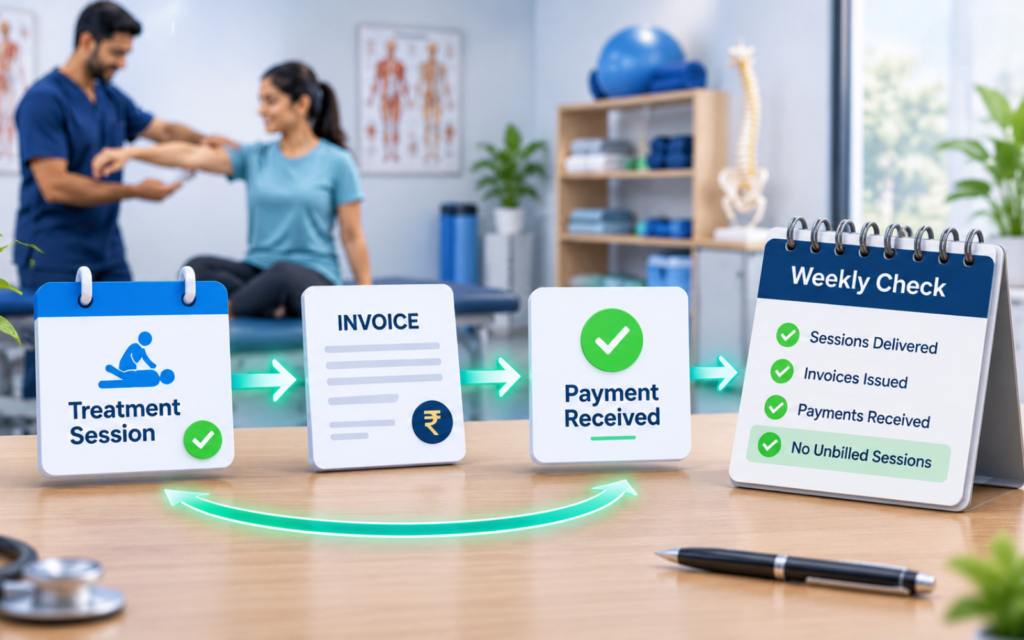

Short answer: A physiotherapy bill should show your clinic’s details, a unique invoice number and date, the patient’s name, a clear description of each service and the number of sessions, the amount, any payment already received, the balance due and how to pay. Use one consistent format so bills are easy to read, reconcile and chase.
Key takeaways
- A good bill answers four questions at a glance: who is billing, who is being billed, what for, and how much is still owed.
- Give every bill a unique, sequential number. Duplicate or missing numbers make reconciliation painful.
- Describe services specifically. “Follow-up session” and “Package of 8 sessions” beat “Treatment”.
- For packages, show the number of sessions, the price and what has been paid, so patients can see the balance.
- Track every bill as paid, partial or overdue, and compare sessions delivered against bills issued so that no session goes unbilled.
- Tax and registration details vary by clinic and location. Ask your accountant which extra fields apply to you.
What is a physiotherapy bill format?
A physiotherapy bill format is the standard layout your clinic uses every time it asks a patient to pay. People use the words bill, invoice and receipt loosely, but they do different jobs. An invoice (or bill) is a request for payment for services provided. A receipt is proof that payment has been made. Many clinics combine the two on one document that shows the amount charged, the amount received and the balance.
The format itself is simply a fixed set of fields in a fixed order. When every bill looks the same, patients know where to find the total, your front desk knows what to fill in, and your accountant knows where to look.
Why does a consistent bill format matter?
Billing problems are rarely dramatic. They are small gaps that repeat. Phyjio’s homepage describes the pattern: sessions get delivered but never invoiced, overdue payments pile up, and following up becomes a manual, uncomfortable process that nobody wants to own.
A consistent format helps in four ways:
- Fewer disputes. A line-by-line description lets a patient see what they are paying for.
- Faster payment. When the total, the due date and the payment method are obvious, patients pay sooner.
- Cleaner records. Sequential numbers and standard fields make monthly reports and audits easier.
- Less friction at the desk. Staff do not have to decide what to write each time.
If billing is a recurring headache in your clinic, our posts on physiotherapy clinic billing problems in India and payment tracking go deeper on the causes.
What fields should every physiotherapy bill include?
The table lists the fields we recommend. The list is our suggested checklist, not a legal requirement. Rules differ by location and by whether you are registered for tax, so confirm the mandatory fields with your accountant.
| Field | Why it matters | Example |
|---|---|---|
| Clinic name, address and contact details | Identifies who is billing and how to reach you | Clinic name, address, phone, email |
| Invoice number | Unique reference for payments and records | Invoice #1024 |
| Invoice date | Starts the payment clock | 23 June |
| Date(s) of service | Links the bill to the visits | Session on 23 June |
| Patient name and ID | Confirms who the bill is for | Patient name, patient ID |
| Therapist | Useful for reports and queries | Treating therapist’s name |
| Service description | Shows exactly what was provided | Initial assessment; follow-up session; package of 8 sessions |
| Quantity and unit price | Makes the total checkable | 5 sessions at 1,000 each |
| Discounts | Keeps adjustments visible | Package discount |
| Taxes, if applicable | Depends on your registration and location | As advised by your accountant |
| Total amount | The full charge | 6,000 |
| Payments received | Shows what has already been paid | 3,000 received on 23 June |
| Balance due | What the patient still owes | 3,000 |
| Payment method and instructions | Tells the patient how to pay | Cash, bank transfer, UPI or card, as you accept |
| Status | Quick view for staff and patients | Paid, partial or overdue |
| Notes and terms | Package validity, a link to your cancellation policy | Short text |
Do not feel pressured to include every field on every bill. A short follow-up visit invoice can be simpler than a package invoice. The important thing is that the same fields appear in the same places each time.
How do you bill per session versus per package?
Most physiotherapy clinics use both. Phyjio’s feature list describes invoice generation per session or per treatment package. The two formats need slightly different information.
Per-session billing
One line per visit, showing the date, the therapist and the service. This is the simplest approach and suits patients who attend irregularly or pay as they go. Make sure that the service description distinguishes an initial assessment from a follow-up, because they are often priced differently.
Package billing
One bill for a defined block of sessions, such as eight sessions. The bill should state the number of sessions included, the package price, the amount paid and the balance. Decide in advance, and write it on the bill or in your terms, what happens if a patient does not use all sessions, whether the package has an expiry, and whether a missed appointment counts as a used session. Our physiotherapy cancellation policy template covers that last point.
Packages often involve part-payments. A bill that shows the amount received and the balance on the same page is easier to follow than a series of separate receipts.
A physiotherapy bill template you can copy
Here is a plain layout to adapt. Move fields around to suit your clinic, but keep the order consistent.
[Clinic name]
[Address] | [Phone] | [Email]Invoice no.: [number] | Date: [date]
Patient: [name] | Patient ID: [ID]
Therapist: [name]Services
[Service description] | [date(s)] | [quantity] x [unit price] = [line total]
[Service description] | [date(s)] | [quantity] x [unit price] = [line total]Subtotal: [amount]
Discount: [amount]
Taxes (if applicable): [amount]
Total: [amount]
Payments received: [amount, date, method]
Balance due: [amount] by [due date]Status: [Paid / Partial / Overdue]
How to pay: [instructions]
Notes: [package validity, policy link, thank-you line]
A fictional worked example
The example below is invented to show how the numbers fit together. The currency and prices are placeholders.
| Line | Quantity | Unit price | Line total |
|---|---|---|---|
| Initial assessment | 1 | 1,500 | 1,500 |
| Follow-up sessions (package) | 5 | 1,000 | 5,000 |
| Subtotal | 6,500 | ||
| Package discount | -500 | ||
| Total | 6,000 | ||
| Payment received | 3,000 | ||
| Balance due | 3,000 |
Check the arithmetic: 1,500 plus 5,000 is 6,500. Less a discount of 500 gives 6,000. With 3,000 received, 3,000 is still due, so the status is “partial”. If the due date passes with the balance unpaid, the status changes to “overdue”.
What do paid, partial and overdue mean?
Phyjio’s homepage shows invoices in three states: paid, partial and overdue. Those are a good set of statuses for any clinic, as long as everyone uses them the same way.
- Paid: the full amount has been received.
- Partial: some payment has been received and a balance remains.
- Overdue: a balance remains and the due date has passed.
Decide your due date up front. Whether it is at the end of the session, within seven days or at the end of a package, state it on the bill, so that “overdue” has a clear meaning. Write down who follows up, how, and when, so overdue bills do not rely on one person remembering.
How do you make sure no session goes unbilled?
Unbilled sessions are quiet losses. The therapist saw the patient, the work was done and nothing was invoiced. A short routine catches them.
- List the day’s attended appointments from your diary.
- Match each one to an invoice, or to a package session that has already been paid for.
- Flag the gaps and bill them the same day.
- Record payments the same day, including the date and method.
- Review overdue bills weekly and follow up on each one.
At the end of the month, compare what you expected to collect with what you actually received. Phyjio’s feature list includes revenue reports with expected versus received amounts, and breakdowns by period, therapist or service type. Our guide to tracking clinic financial health in five minutes a day shows a lightweight way to do this.
Common physiotherapy billing mistakes
- Duplicate or missing invoice numbers. Use one numbering sequence and never reuse a number.
- Vague service descriptions. “Treatment” does not tell a patient what they paid for.
- No balance line. Patients with part-payments need to see what remains.
- Editing issued bills. As a good habit, correct a mistake with a clearly marked correction rather than quietly changing a bill the patient has already seen. Ask your accountant how corrections should be handled for your records.
- Recording payments late. A payment recorded a week later makes the status wrong in between.
- No due date. Without one, no bill is ever formally overdue.
- Mixing clinic and personal accounts. Keep patient payments in the clinic’s own account for clean records.
How should you handle patient information on bills?
A bill contains personal information: the patient’s name, the services they received and what they paid. Treat it with the same care as the clinical record. Share bills only with the patient or their authorised representative, avoid sending them through open group chats, and limit who in your team can export billing data.
India’s data-protection rules are being phased in, and our guide to the DPDP Act for physiotherapy clinics explains what they mean for patient data. A written process for who handles bills and where copies are kept also helps. Our post on physio clinic systems and processes shows how to set that up.
How can clinic software help with billing?
Software removes most of the manual copying. Phyjio’s homepage describes generating invoices in seconds, per session or per treatment package, recording payments, and tracking what is paid, partial and overdue. It also lists revenue reports by period, therapist or service type, and integration with standard payment methods. Check during a demo exactly how your own bill format, numbering and tax fields would be set up, since those depend on your clinic.
If you are weighing options, our guide to choosing physiotherapy practice management software lists the billing questions to ask.
Frequently asked questions
What should be on a physiotherapy invoice?
Include your clinic’s details, a unique invoice number, the date, the patient’s name, the services with quantities and prices, the total, payments received, the balance due and how to pay. Add tax details if they apply to you.
What is the difference between a bill, an invoice and a receipt?
A bill or invoice requests payment for services. A receipt confirms that payment has been received. Many clinics use a single document that shows all three: the charge, the payment and the balance.
Should physiotherapy sessions be billed individually or as a package?
Both work. Per-session billing is simplest for patients who attend irregularly. Package billing suits a planned course of treatment. Whichever you use, state the number of sessions, the price and any terms clearly.
How do I show a part-payment on a bill?
List the total, then the payment received with its date and method, then the balance due. Mark the status as partial until the balance is cleared.
How do I avoid forgetting to bill a session?
Compare the day’s attended appointments with the invoices or package sessions recorded, and bill any gaps the same day.
Do I need to add tax to my physiotherapy bills?
That depends on your registration and location. This guide cannot say what applies to you. Ask your accountant or tax adviser which fields and rules are relevant to your clinic.
Where to go from here
Pick one bill layout, share it with your front desk and use it for every patient from this week. Then add the daily check that matches attended sessions to bills. Those two habits fix most billing leaks. If you want invoices, payment status and revenue reports in one place, you can start a free Phyjio trial or book a demo.