
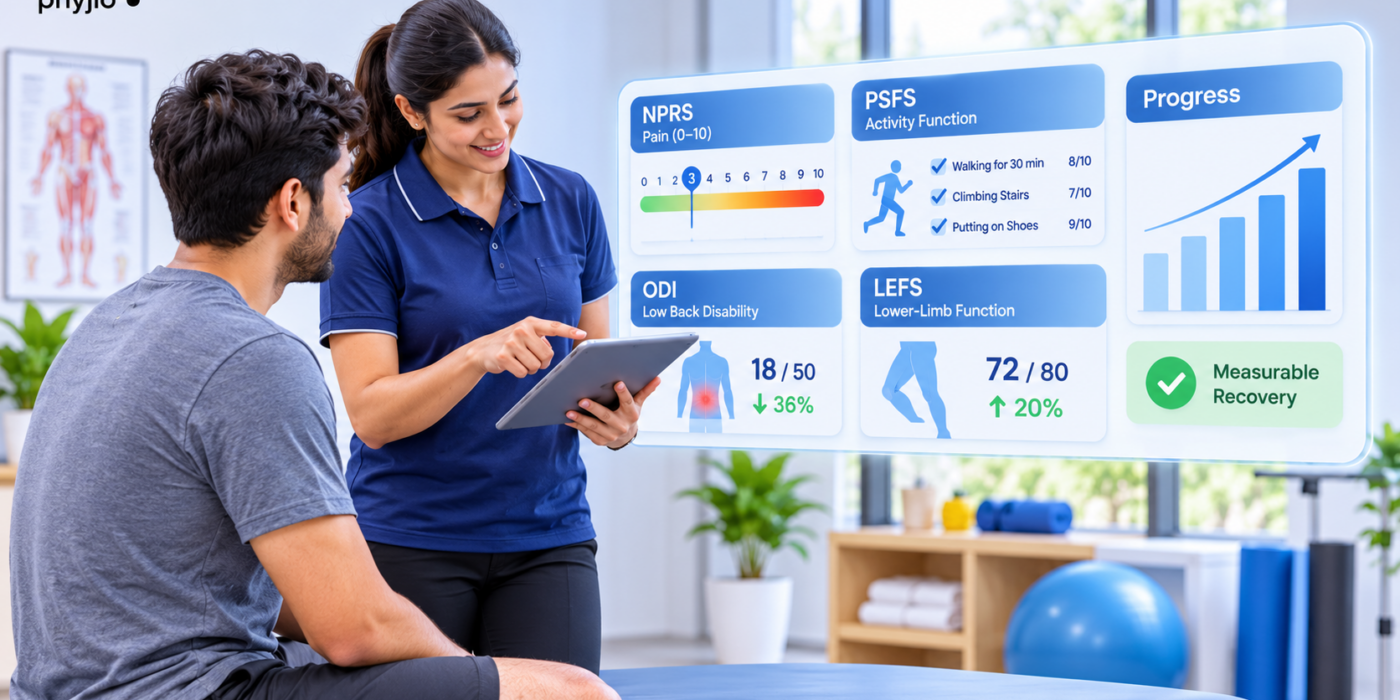
Short answer: Physiotherapy outcome measures are standardised tools that turn pain, function or disability into a score you can repeat. Common choices include the Numeric Pain Rating Scale (NPRS) for pain intensity, the Patient Specific Functional Scale (PSFS) for individual activities, the Oswestry Disability Index (ODI) for low back pain and the Lower Extremity Functional Scale (LEFS) for lower-limb conditions.
Key takeaways
-
An outcome measure is only useful if you take it at baseline and repeat it with the same method, so the numbers can be compared.
-
The NPRS is quick and simple, but it measures one thing only: pain intensity. Pair it with a function measure.
-
The PSFS lets the patient choose up to five activities that matter to them, which keeps treatment goal-focused.
-
The ODI is specific to low back pain, and the LEFS is specific to lower-limb conditions. Use condition-specific tools where one fits.
-
Published change thresholds, such as 2 points on the NPRS or 9 points on the LEFS, are guides from specific studies, not guarantees for every patient.
What are outcome measures in physiotherapy?
An outcome measure is a standardised way of recording how a patient is doing, so that you can compare their status at different points in time. Most of the tools in this guide are patient-reported: the patient rates their own pain, difficulty or disability, and you calculate a score.
That matters because memory and impressions are unreliable. “She seems better” is hard to defend and impossible to chart. “Pain fell from 7 to 3 and she can now stand for 30 minutes” is something you and the patient can both check. Outcome measures also give you the “measurable terms” that good session notes rely on, which we cover in our guide to physiotherapy SOAP notes.
Why should a clinic track outcome measures?
There are three practical reasons. First, tracking shows you whether a treatment plan is working, early enough to change it. Second, it gives the patient visible evidence of progress, which Physiopedia lists as an advantage of the PSFS because it gives the patient positive reinforcement that the intervention is effective. Third, over time it tells the clinic, not just the individual therapist, what is happening across patients.
It also supports retention. Patients who can see progress have a reason to keep coming back, and patients whose scores are not moving give you an early prompt to review the plan. Our posts on why patients quit physiotherapy early and tracking progress and dropout risk look at that link in more detail.
How does the Numeric Pain Rating Scale (NPRS) work?
The NPRS is a one-dimensional measure of pain intensity in adults. According to Physiopedia, the patient picks a whole number from 0 to 10 that best reflects their pain intensity, where 0 represents one extreme such as “no pain” and 10 the other, such as “pain as bad as you can imagine” or “worst pain imaginable”. The most commonly used version has eleven points. The recall period varies, but patients are most often asked about pain over the last 24 hours or about their average pain.
You can ask the question out loud, including over the phone, or give the patient a printed scale to complete. Scores range from 0 to 10, with higher scores indicating greater pain intensity.
Strengths: It takes under a minute, is easy to administer and score, and Physiopedia notes minimal translation difficulty across languages and cultures. Physiopedia also reports high test-retest reliability in patients with rheumatoid arthritis (r = 0.96 for literate and 0.95 for illiterate patients).
Limitations: It captures only one component of pain. It does not reflect how pain affects sleep, work or mood, or the way symptoms fluctuate, so use it alongside a function measure.
Meaningful change: Physiopedia summarises studies, including work in low back pain patients after physical therapy and in shoulder pain, which found a reduction of about 2 points, or 30%, to be clinically important.
How does the Patient Specific Functional Scale (PSFS) work?
The PSFS was developed by Stratford and colleagues in 1995, according to Physiopedia, as a self-report measure of function that can be used with patients at varying levels of independence. Instead of a fixed questionnaire, the patient names the activities that matter.
-
Ask the patient to identify up to five important activities they cannot do, or have difficulty with, because of the problem. Examples include putting on socks or shopping.
-
Ask them to rate the current level of difficulty for each activity on an 11-point scale, where 0 means “unable to perform” and 10 means “able to perform at prior level”.
-
After the intervention, ask them to rate the same activities again. They can also nominate new problem activities that have appeared.
Where it fits: Physiopedia describes the PSFS as a valid, reliable and responsive measure for patients with back, neck, knee and upper extremity problems, and notes it can be used across a wide variety of musculoskeletal and neurological conditions.
Advantages: It keeps therapy goal-oriented, is quick to complete and relatively easy for patients, and helps redirect the subjective assessment from pain towards function.
Limitations: Physiopedia lists a few. If a patient cancels their final appointment, you may not obtain a final score. Some patients find numerical rating of activities difficult. And because it is not condition-specific, you may need an additional condition-specific measure.
How does the Oswestry Disability Index (ODI) work?
The ODI is a patient-completed questionnaire that gives a percentage score for level of function (disability) in daily activities in people rehabilitating from low back pain. Physiopedia says it was developed by Jeremy Fairbank and Graham Pynsent in Oswestry, England, in 1980, and describes it as considered the gold standard of low back functional outcome tools. It is intended for acute or chronic low back pain. Physiopedia adds that it is most effective for persistent severe disability, whereas the Roland-Morris questionnaire is better for mild to moderate disability.
The questionnaire covers ten everyday areas: pain intensity, personal care, lifting, walking, sitting, standing, sleeping, sex life (if applicable), social life and travel. Each section has six statements scored from 0 to 5, where 0 is the least disability and 5 the greatest. The total is then expressed as a percentage, from 0% (no disability) to 100% (the highest level of disability).
|
ODI score |
Band (as listed by Physiopedia) |
|---|---|
|
0% to 20% |
Minimal disability |
|
21% to 40% |
Moderate disability |
|
41% to 60% |
Severe disability |
|
61% to 80% |
Labelled “crippled” in the table Physiopedia reproduces; back pain affects all aspects of life |
|
81% to 100% |
The highest band |
Treat the band names as clinical shorthand. Some of the labels are blunt, and you may prefer neutral language when talking to patients. Physiopedia also notes that the ODI has traditionally been applied on paper, and that electronic systems and online calculators now exist for scoring it.
How does the Lower Extremity Functional Scale (LEFS) work?
The LEFS is a self-report questionnaire for adults with lower-limb conditions, such as hip osteoarthritis or knee and hip replacement. Physiopedia says it is used to measure the patient’s initial function, ongoing progress and outcome. Patients answer the question “Today, do you or would you have any difficulty at all with:” for twenty everyday activities, choosing from five options that run from extreme difficulty or unable to perform, through quite a bit, moderate and a little bit, to no difficulty.
The maximum possible score is 80, indicating very high function, and the minimum is 0, indicating very low function. Physiopedia reports that the minimum detectable change and the minimum clinically important difference are both 9 points, meaning that a change of more than 9 points is a meaningful change in function. It also notes the LEFS has an error of plus or minus 5 points. Taking the scale at regular intervals lets you document progress through the course of treatment.
Which outcome measure should you choose?
No single tool does everything. The table summarises what we have covered. The “use it for” column is our reading of the sources, so adjust it with your professional judgement.
|
Measure |
Measures |
Score range |
Reported meaningful change |
Main limitation |
|---|---|---|---|---|
|
NPRS |
Pain intensity |
0 to 10 |
About 2 points or 30% |
One dimension of pain only |
|
PSFS |
Patient-chosen activities |
0 to 10 per activity |
Not covered in this guide |
Final score can be missed if the last visit is cancelled |
|
ODI |
Disability from low back pain |
0% to 100% |
Not covered in this guide |
Specific to low back pain |
|
LEFS |
Lower-limb function |
0 to 80 |
9 points |
Specific to lower-limb conditions |
A simple starting rule for most clinics is to record one pain measure and one function measure at baseline. For example, the NPRS plus the PSFS works for many patients, and you can add the ODI for low back pain or the LEFS for a lower-limb problem. Keep the set small. A clinic that tries to use ten tools ends up using none consistently.
When should you take outcome measures?
Take a baseline at the first assessment, repeat at planned points during the course of treatment, and take a final measure at discharge or reassessment. Align repeat measures to your reassessment schedule rather than leaving them to chance.
Physiopedia’s note on the PSFS shows why planned timing matters. If a patient cancels the last appointment, the final score may never be collected. Build the final measure into a planned reassessment visit, not the last-minute close-out, and consider asking for it in the second-to-last session as a back-up.
Keep the method consistent. Use the same wording, the same recall period and, where you can, the same person asking. A pain score taken verbally at one visit and on paper at the next is not strictly comparable.
What counts as a meaningful change?
Scores move for many reasons, including measurement error. That is why researchers define thresholds such as the minimum detectable change (the smallest change that is more than measurement error) and the minimum clinically important difference (the smallest change that matters to the patient). For the LEFS, Physiopedia gives 9 points for both. For the NPRS, it summarises a 2-point or 30% reduction as clinically important in several studies.
Use those numbers as guides, not rules. The studies behind them involved particular groups of patients, and your patient may differ. A 2-point drop in pain matters more to someone who started at 4 than to someone who started at 9. Combine the score with what the patient tells you and what you see.
A fictional example of tracking one patient
The patient below is invented for illustration, and the scores are not from a real case. It shows how two measures can tell a fuller story than either alone.
|
Measure |
Visit 1 |
Visit 6 |
Change |
Comparison with reported threshold |
|---|---|---|---|---|
|
NPRS (pain) |
7 |
3 |
4-point reduction |
More than the 2-point guide |
|
LEFS |
38 |
49 |
11-point gain |
More than the 9-point guide |
|
PSFS: “climb the stairs at home” |
3 |
7 |
4-point gain |
No threshold applied here |
Read together, the numbers suggest a genuine improvement in pain and function. The PSFS line tells the therapist something the other two cannot: the activity the patient cares about most has moved from 3 to 7 out of 10. That is a conversation worth having at the next visit.
How do you build outcome measures into daily clinic work?
-
Choose a short standard set. One pain measure and one function measure for every patient, plus a condition-specific tool where one fits.
-
Write it into your intake process. The baseline is taken at the first assessment, not “when there is time”.
-
Set reassessment points. Put them in the treatment plan so they are booked, not remembered.
-
Record scores in one place. Scattered scores on paper are hard to compare.
-
Show the patient. Share the baseline and the latest score, and talk about what has changed.
-
Review across patients. Once a month, look at how scores are moving across the clinic, not just case by case.
Our physiotherapy treatment plan template shows where goals and reassessment points fit, and the physiotherapy clinic KPI dashboard guide covers the clinic-level numbers worth reviewing.
Common mistakes with outcome measures
-
Measuring once. A baseline with no follow-up tells you nothing about change.
-
Changing the tool midway. Switching from one scale to another breaks the comparison.
-
Using pain alone. A patient can be less painful but still unable to do what matters to them.
-
Treating the threshold as a verdict. A 2-point change is a guide, not a pass mark.
-
Missing the final score. Plan the last measurement before the patient stops attending.
-
Not using the data. If scores are collected and never discussed, patients stop taking them seriously.
How can clinic software support outcome tracking?
Software helps with the “record it in one place” step. Phyjio’s feature list includes session-by-session progress tracking against treatment goals, therapist notes and progress documentation per session, visual progress indicators for each patient’s plan, and exercise prescription with compliance logging. How your clinic records a given score, for instance within the session notes, is a decision for your team and your clinical protocols.
If you are still comparing options, our guide to choosing physiotherapy practice management software lists what to look for. Or book a demo and ask how the system handles the scores your clinic uses.
Frequently asked questions
What is the best outcome measure in physiotherapy?
There is no single best tool. The right choice depends on the condition and the question. A simple pairing of a pain measure such as the NPRS and a function measure such as the PSFS suits many patients, with a condition-specific tool added where one fits.
How is the Numeric Pain Rating Scale scored?
The patient chooses a whole number from 0 to 10, where 0 is no pain and 10 is the worst pain imaginable. Higher numbers mean greater pain intensity.
What is the PSFS used for?
The PSFS records how difficult the patient finds up to five activities that matter to them, each rated from 0 (unable to perform) to 10 (able to perform at prior level). It is repeated after treatment to show change.
What does an Oswestry score mean?
The ODI score is a percentage of disability from low back pain, where a higher percentage means greater disability. Physiopedia lists bands from minimal (0% to 20%) through moderate and severe to higher levels.
What change on the LEFS is meaningful?
Physiopedia reports that both the minimum detectable change and the minimum clinically important difference for the LEFS are 9 points. Treat that as a guide and combine it with clinical judgement.
How often should outcome measures be repeated?
Take a baseline at the first assessment, repeat at planned reassessment points, and take a final measure at discharge. Exact intervals depend on your protocols and the patient’s condition.
Where to go from here
Start small. Pick one pain measure and one function measure, make the baseline part of every first visit, and schedule the reassessment before the patient leaves. Within a few weeks you will have numbers you can discuss with patients and review as a team.
If you would like your patient records, session notes and progress tracking in one system, you can start a free Phyjio trial.