
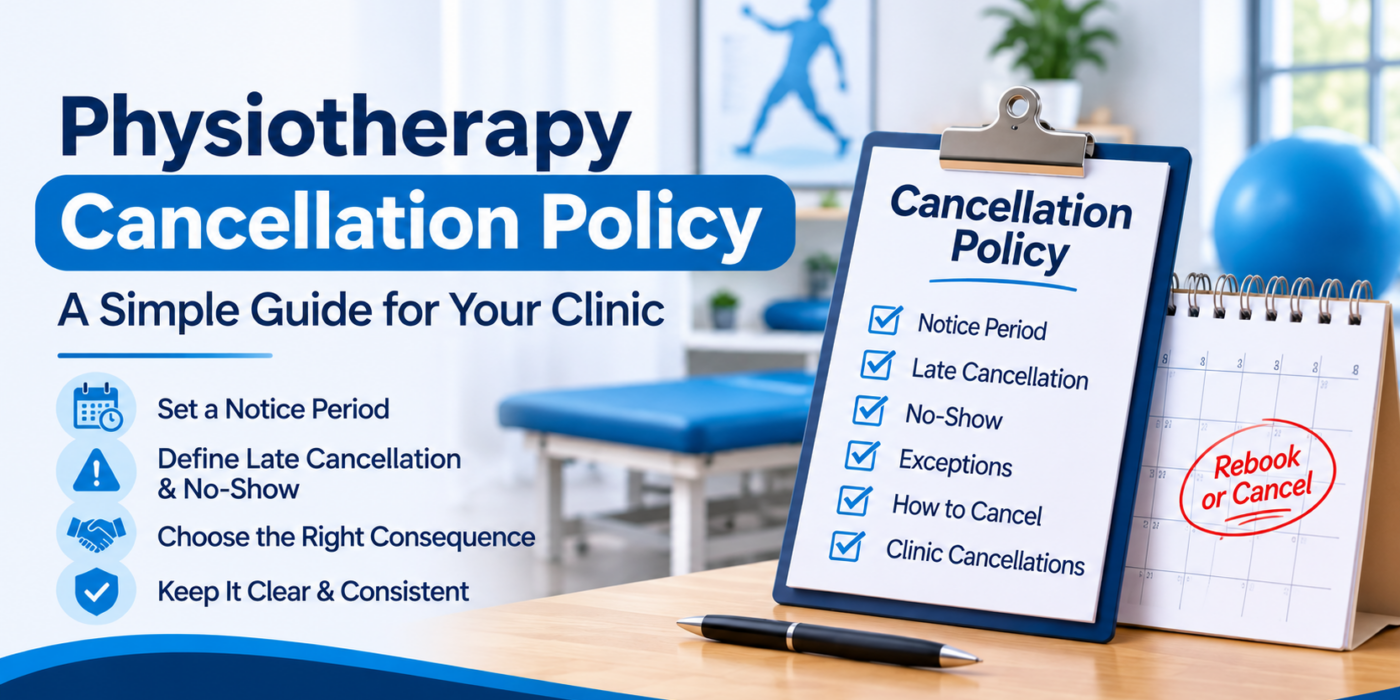
Short answer: A physiotherapy cancellation policy is a short written rule that tells patients how much notice you need to cancel or rebook, what happens if they miss an appointment, and when exceptions apply. A good one is clear, shown before the first visit, applied consistently, and backed by reminders and a waitlist to refill freed slots.
Key takeaways
-
A cancellation policy protects your therapists’ time and the patients waiting for a slot. It works best when it is short, specific and shown before the first appointment.
-
You decide the consequences. Options range from a friendly rebooking conversation to a fee or deposit, and each has trade-offs.
-
Consistency matters more than strictness. Write down who may waive a charge and why, so every patient is treated the same way.
-
Reminders, a waitlist and a clear rebooking habit reduce the damage of late cancellations, whatever your policy says.
-
Track late cancellations and no-shows as a rate so you can tell whether the policy is working.
What is a physiotherapy cancellation policy?
A cancellation policy is the written set of rules a clinic uses when a patient cancels, reschedules or does not turn up. It covers how much notice is needed, how patients should tell you, what happens if they do not give enough notice, and which situations you will treat as exceptions. It also covers the other direction: what the patient can expect when the clinic has to cancel.
It does not need to be long. One page, or even a short paragraph on your booking confirmation, is enough if it answers the questions patients actually ask. The aim is to make expectations clear before there is a problem, so that nobody has to negotiate at the front desk on the day.
Why does a physiotherapy clinic need a cancellation policy?
Physiotherapy runs on booked time. When a patient cancels at short notice or does not attend, the therapist’s slot may go unused, and another patient who wanted that time may have been turned away. Phyjio’s own homepage describes the problem: appointment management by phone and calendar apps leads to double bookings, missed appointments and wasted therapist time.
The topic is also something the wider practice-management industry is talking about. Jane, a practice management platform for health and wellness practitioners, listed “how to reduce late cancellations without making every conversation about fees” among the pieces in the latest issue of its Front Desk magazine, as shown on its blog in October 2026. That headline captures the real tension: you want to protect your schedule without damaging the relationship with the patient.
Without a policy, every late cancellation becomes a judgement call. Front-desk staff improvise, patients compare experiences, and your most understanding patients quietly subsidise the others. A written policy replaces improvisation with a shared rule.
What should a cancellation policy include?
Seven elements cover most clinics. Each one answers a question a patient might ask.
1. The notice period
State exactly how much notice you need. “24 hours” is clearer than “reasonable notice”. Choose a window that gives you a realistic chance of refilling the slot. If you rarely have a waitlist, a longer window may not help you.
2. Definitions: late cancellation and no-show
Separate the two. A late cancellation is when the patient lets you know, but inside the notice period. A no-show is when they do not attend and have not told you. You may want to treat the second more seriously, because you get no chance to refill the slot.
3. The consequence
Say what happens. This might be a conversation and a rebooking offer, a fee, a deposit held against the next visit, or a session deducted from a package. Pick what suits your patients and your market. The options table below compares them.
4. Exceptions
List what you will usually waive: illness, emergencies, bereavement, or clinic-side problems such as a therapist being unwell. Name the person who can approve a waiver. If you do not, the front desk is left to decide alone.
5. How to cancel or reschedule
Tell patients which channels you monitor, such as a phone number or an email address, and when. A patient who messages a therapist’s personal phone at midnight should not be treated as late if your policy never told them where to write.
6. Clinic cancellations
Promise what you will do when you cancel: tell the patient as early as you can and offer the next available slot. It signals fairness and sets the tone for the whole policy.
7. Acknowledgement
Ask the patient to confirm they have read the policy, for example on the intake form or the booking confirmation. Record that confirmation in their file.
Which consequence should you choose?
There is no single right answer. The table below sets out common options with the trade-offs. It reflects our view, not a legal or industry standard, and you should check with a legal or financial adviser before introducing any charge.
|
Option |
How it works |
Upside |
Watch out for |
|---|---|---|---|
|
Conversation and rebooking |
Contact the patient, ask what happened and rebook |
Preserves goodwill |
No deterrent if a patient repeatedly cancels late |
|
Warning, then fee |
First late cancellation gets a reminder of the policy; later ones are charged |
Feels fair, gives a chance to adjust |
Needs consistent record-keeping |
|
Flat late-cancellation fee |
A set amount applies to every late cancellation or no-show |
Simple to explain |
Can feel harsh, so exceptions must be clear |
|
Deposit or card on file |
Patient pays or guarantees an amount at booking |
Strong commitment signal |
Adds a step at booking and may put some patients off |
|
Deduct a session from a package |
A missed slot counts as a used session |
Fits package billing |
Patients must understand this when they buy the package |
If you use fees, make sure the amount is stated in advance in writing. A charge that the patient first hears about after the event is more likely to cause a dispute.
A cancellation policy template you can copy
Adapt the wording below to your clinic’s tone and services. Replace the square-bracket items with your own details, and have an adviser review it if you charge fees. This is a starting point, not legal text.
Our appointment policy
We keep each appointment time for you, and we know that plans sometimes change. To help us offer your slot to another patient, please let us know at least [24 hours] before your appointment if you need to cancel or reschedule. You can reach us by [phone number or email] during [opening hours].
If you cancel with less notice than this, or do not attend, we will [contact you to rebook / send a reminder of this policy / apply a fee of (amount)]. We understand that illness and emergencies happen, so please tell us what has happened and we will [review it with you / consider it].
If we need to cancel or move your appointment, we will tell you as early as possible and offer you the next available time.
By booking, you confirm that you have read this policy.
Keep the tone warm. Patients are more likely to follow a rule that sounds like it came from a person.
How do you tell patients about the policy?
A policy only works if patients have seen it. Put it in four places so it is hard to miss.
-
At booking. Include the policy, or a link to it, in the confirmation.
-
On the intake form. Ask for acknowledgement during registration.
-
In reminders. A short line about how to reschedule is more useful than a long paragraph.
-
At the front desk. A small printed copy or sign helps staff point to a rule rather than defend a personal decision.
Give your front desk two or three ready phrases so they do not have to improvise. For example: “I’m sorry, I can see this fell inside our notice window. Let me check how we handle that.” Or: “Thank you for letting us know. Shall we find you a new time now?” The second phrase matters most, because a patient who leaves without rebooking is a patient at risk of dropping out of treatment.
How do you enforce it without damaging relationships?
Enforcement is where most policies succeed or fail. Four habits help.
-
Decide in advance, not in the moment. Write down which situations are waived automatically, which need a manager, and which are charged.
-
Apply the same rule to everyone. A patient who sees a rule waived for someone else will expect the same.
-
Record every decision. Note the date, the reason and who approved a waiver. A simple log makes patterns visible.
-
Keep the conversation about care. Start with the patient’s treatment plan, then the policy. Missing sessions may delay recovery, which is a better reason to reschedule than a fee.
If a patient repeatedly cancels late, treat it as clinical information. It may signal difficulty attending, pain, cost concerns or loss of motivation, which is worth a conversation. Our guide to churn rate in a physio clinic explains how to spot patients who are drifting away.
How can you reduce late cancellations in the first place?
A policy deals with the consequence. These habits reduce how often it is needed.
-
Send reminders. Phyjio’s feature list includes automated appointment reminders by SMS and email before each appointment.
-
Rebook before the patient leaves. Booking the next session at the end of the current one makes the appointment feel like part of the plan.
-
Give a reason to attend. Tell patients what the next session will achieve. Patients who see the point rarely drop it.
-
Ask why. Log the stated reason for each cancellation. Patterns such as a particular day or time slot will tell you whether the cause is on your side.
For more on what reminders can and cannot do, see our posts on AI-powered patient scheduling and no-shows and AI reminders and follow-ups for patient retention.
How do you refill a cancelled slot?
A late cancellation hurts less if you can fill the gap. A waitlist is the simplest way. Keep a list of patients who would like an earlier or more convenient time, and have a standard way of contacting them when a slot opens. Phyjio’s feature list includes waitlist management for popular appointment slots, a therapist-level calendar with availability management, and multi-branch scheduling.
Whatever tool you use, agree some rules: who contacts the waitlist, how long you wait for a reply before moving to the next person, and how you record the result. Our guide to physiotherapy diary management covers how to keep the diary full and organised.
How do you know whether the policy is working?
Measure two simple rates each month.
-
Late cancellation rate: late cancellations divided by total booked appointments.
-
No-show rate: no-shows divided by total booked appointments.
Here is a fictional example. A clinic books 120 appointments in a month, with 9 late cancellations and 4 no-shows. The late cancellation rate is 9 divided by 120, which is 7.5%, and the no-show rate is 4 divided by 120, which is about 3.3%. The numbers are invented for illustration. Your own figures will differ, and no outside benchmark is implied.
Track three more things alongside them: how many charges were waived, how many cancelled slots were refilled, and how many cancelling patients rebooked within a week. If late cancellations fall and rebooking rises, the policy is probably doing its job. If complaints rise, review the wording and the exceptions.
What special cases should you plan for?
-
Treatment packages. Decide whether a missed session counts as used, and say so when the package is sold.
-
First appointments. New patients may not have read the policy yet. Some clinics are more flexible on a first visit.
-
Children and guardians. Make sure the person who books also receives the policy.
-
Clinic-initiated cancellations. Offer an alternative slot promptly and never charge for a cancellation you caused.
-
Medical or emergency situations. Give staff a clear rule so they do not have to weigh a patient’s explanation alone.
Common cancellation policy mistakes
-
Writing it but not showing it. A policy patients never saw is hard to enforce.
-
Vague wording. “Reasonable notice” invites argument. State the hours.
-
Inconsistent enforcement. Waiving for some patients and charging others damages trust.
-
No rebooking step. A cancellation that ends without a new appointment is a lost patient.
-
Ignoring the data. If you never count cancellations, you cannot tell what to change.
-
Forgetting your own cancellations. Patients notice when a policy only binds them.
How can clinic software help?
Most of the work above is routine: sending reminders, spotting gaps, contacting the waitlist, recording decisions and issuing invoices if you charge. According to its feature list, Phyjio includes automated reminders by SMS and email, waitlist management, therapist-level calendars, invoice generation per session or package, and payment status tracking across paid, partial and overdue invoices. Whether you set up fees at all is your choice.
If you want to automate more of the routine, our guide to physio clinic automation tools lists what to automate first, and our post on increasing patient retention covers the bigger picture.
Frequently asked questions
Should a physiotherapy clinic charge a cancellation fee?
That is a business and legal decision. Fees can deter late cancellations but can also upset patients. Consider starting with a warning, make any fee clear in writing before the first visit, and ask an adviser how local rules apply to you.
How much notice should a cancellation policy require?
There is no single rule. Choose a window that gives you a realistic chance of refilling the slot. You might start with 24 hours and review the numbers after a month.
What is the difference between a late cancellation and a no-show?
A late cancellation is when the patient tells you, but inside the notice period. A no-show is when they do not attend and have not told you in advance.
Should the policy apply to the first appointment?
It can, but some clinics choose to be flexible on a first visit because the patient may not yet have seen the policy. Whatever you decide, write it down so staff handle it consistently.
How do I tell patients about the policy?
Include it in the booking confirmation, ask for acknowledgement on the intake form, mention how to reschedule in reminders, and keep a short printed copy at the front desk.
What should happen when the clinic cancels?
Tell the patient as early as possible, offer the next available slot and do not charge for a cancellation the clinic caused.
Where to go from here
Start with the template, adapt the notice period and consequence to your patients, and put it in your booking confirmation this week. Then count late cancellations and no-shows for a month and see what changes. If you would like reminders, a waitlist and your diary in one place, you can start a free Phyjio trial or book a demo.
Last verified: 3 November 2026, against Phyjio’s published feature list and the Jane blog listing of October 2026. Policy wording and examples are suggestions, not legal advice. Check with a qualified adviser before introducing fees or deposits.