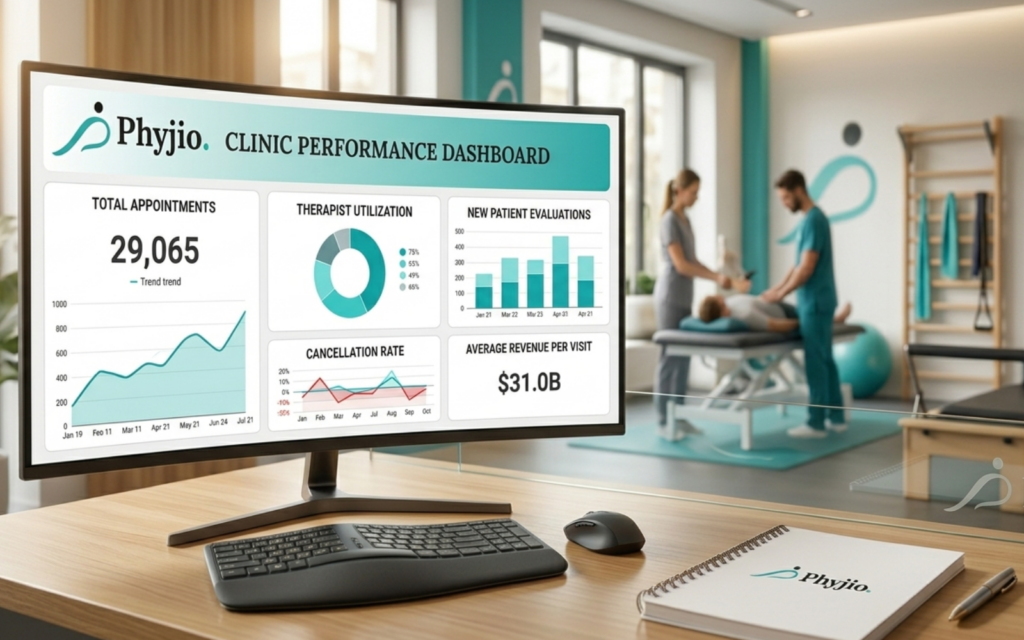

How to Track Your Clinic’s Financial Health in 5 Minutes a Day
Managing a successful rehabilitation practice requires a continuous balancing act between patient care and business operations. Many clinic owners find themselves buried under clinical documentation, missing the critical signals that indicate whether their business is thriving or leaking revenue.
You do not need an advanced degree in corporate accounting or hours of spare time to keep your business on track. By establishing a focused, modern workflow, you can accurately evaluate your clinic’s fiscal performance in less time than it takes to brew a cup of coffee.
TL;DR Summary
-
The Goal: Monitor critical cash flow, collections, and practitioner productivity metrics daily to protect your margins.
-
The Problem: Manual bookkeeping creates visibility blind spots, leading to unbilled sessions, high cancellation rates, and delayed insurance reimbursements.
-
The Solution: Transition from manual spreadsheets to dedicated cloud-based platforms like Phyjio to automate data capture and access an instantaneous, real-time clinic financial dashboard.
-
The Daily Routine: Spend exactly five minutes reviewing completed sessions, clean collection rates, outstanding balances, and open scheduling slots.
What Is Clinic Financial Health?
Clinic financial health is the structural evaluation of a medical or rehabilitation practice’s operational viability, measured by its ability to consistently generate positive net profit, maintain liquid cash flow, manage outstanding liabilities, and optimize revenue cycle management.
In a specialized rehabilitation setting—such as a musculoskeletal or sports injury practice—maintaining baseline clinic financial health requires tracking how effectively clinical time translates into collected revenue. Unlike traditional retail, healthcare practices navigate unique challenges like complex insurance claims, split patient copays, multiple service packages, and variable provider utilization rates. Real sustainability means that your gross revenue comfortably covers fixed operational expenses, therapist compensation, and equipment overhead, while consistently leaving an adequate net profit margin for business scaling.
Why Daily Financial Tracking Matters
Waiting for end-of-month or end-of-quarter accounting reports to assess your financial status is a high-risk operational strategy. In private healthcare practices, financial problems accumulate incrementally. A sudden spike in missed follow-ups or an unaddressed technical glitch in electronic insurance submissions can quietly drain thousands of dollars before your accountant compiles your monthly statements.
Daily monitoring allows you to maintain continuous oversight of your practice’s cash position. For example, if your physiotherapy clinic financial management process identifies a sudden drop in appointment utilization on a Tuesday afternoon, you can immediately direct front-desk staff to engage patients on your waitlist. Similarly, monitoring daily billing cycles ensures that clinical notes are locked and processed immediately, directly compressing your overall accounts receivable lifecycle and preventing long-term billing leakage.
Can You Really Monitor Your Clinic in Just 5 Minutes?
The short answer is yes—but only if you shift away from manual documentation and separate spreadsheets. If your administrative staff must manually cross-reference paper appointment books, physical payment receipts, and banking records, a thorough financial review will easily take hours.
Achieving a precise five-minute review relies entirely on centralized data structures and dashboard automation. When you deploy specialized healthcare practice management software, every booking action, completed diagnostic assessment, and processed copay automatically updates an integrated cloud ledger. Instead of pulling fragmented records, you simply open your device, check a single clinic KPI dashboard, review the vital metrics, and close it.
The 9 Financial Metrics Every Clinic Should Check Daily
To maintain an efficient 5-minute review process, you must filter out secondary data and focus strictly on high-leverage indicators. These nine daily metrics give you an instantaneous snapshot of your practice’s operational and financial health.
1. Today’s Gross Revenue
The absolute total monetary value generated by your practice within the current business day. This includes cash collections, processed credit card transactions, digital wallet top-ups, and recorded insurance bills.
2. Appointments Completed vs. Scheduled
This operational metric tracks your daily production capacity. Monitoring this number helps you instantly evaluate your true clinic productivity and see exactly how much scheduled appointment revenue was successfully realized.
3. Total Outstanding Payments (Accounts Receivable)
The balance of money owed to your clinic by private patients, third-party payers, or corporate accounts. Tracking this daily ensures your administrative team is actively pursuing outstanding invoices before they turn into uncollectible debt.
4. Clean Collection Rate
The percentage of total billed encounters successfully collected at the point of care or smoothly reimbursed on the first claim submission. A healthy target is typically $\ge 95\%$. Drops below this line indicate immediate issues in front-desk collections or billing workflows.
5. New Patient Admissions
The volume of fresh intakes entering your care pipeline. New patient flow is the primary driver of future revenue and acts as an early warning indicator for your long-term patient lifetime value.
6. Returning Patient Retention Rate
The percentage of active patients returning for their scheduled multi-session treatment plans. If new patient metrics look strong but returning numbers are dropping, your clinic may be struggling with patient drop-offs or incomplete care plans.
7. Essential Daily Operating Expenses
Your fixed and variable operational overhead—including practitioner wages, medical supplies, software subscriptions, and rent—calculated down to a daily baseline figure. Knowing this number gives you a clear target for daily break-even generation.
8. Net Profit Estimate
Your calculated net profit after subtracting your daily operating expenses from your gross daily revenue:
$$\text{Net Profit Estimate} = \text{Gross Daily Revenue} – \text{Daily Operating Costs}$$
This calculation gives you immediate clarity on whether your business operated in the green or the red today.
9. Cancellation and No-Show Rates
The percentage of booked sessions that were canceled or missed without adequate notice. High cancellation rates directly damage clinic profitability by creating permanent gaps in therapist availability.
High-Impact Financial KPIs Explained
|
Financial Metric / KPI |
Ideal Target Benchmark |
Why It Matters for Private Practices |
|
Clean Collection Rate |
$95\% – 98\%$ |
Ensures you collect what you earn without wasting time chasing aging debt. |
|
Appointment Utilization Rate |
$85\% – 92\%$ |
Measures how effectively your practice’s available therapist hours are filled. |
|
Cancellation & No-Show Rate |
$< 5\%$ |
Minimizes wasted provider availability and keeps patient care plans on track. |
|
Days in Accounts Receivable (A/R) |
$< 30 \text{ Days}$ |
Tracks how long it takes for your clinic to receive cash for provided services. |
Step-by-Step: Your 5-Minute Daily Financial Routine
Transforming financial tracking into an effortless daily habit requires a structured sequence. Execute this practical workflow during the final fifteen minutes of the business day:
Minute 1: Verify the Daily Schedule and Closed Invoices
-
Open your physiotherapy practice management software and navigate to the daily calendar view.
-
Ensure every completed patient encounter is accurately linked to a generated invoice.
-
Check for any open or unbilled appointments to completely eliminate end-of-day revenue leakage.
Minute 2: Evaluate Point-of-Care Collections
-
Review the daily cash, digital payment, and card transactions on your core clinic revenue tracking interface.
-
Verify that all patient copays and outstanding invoices due today were successfully collected by the front desk.
Minute 3: Audit Outstanding Claims and Balances
-
Check your billing dashboard for any instantly rejected insurance claims or failed payments.
-
Flag newly aging balances over 30 days so your administrative staff can prioritize them tomorrow morning.
Minute 4: Check Care Plan Progress and Continuity
-
Review new patient intake numbers alongside your active treatment plans.
-
Confirm that discharging patients or individuals finishing automated packages are seamlessly re-engaged for wellness programs or follow-ups.
Minute 5: Review the Daily Net Profit Summary
-
Look at your automated financial summary screen to review today’s gross revenue against your daily fixed overhead baseline.
-
Evaluate your ultimate net profit margin for the day, confirm your positive cash flow position, and securely close out the dashboard.
Manual Tracking vs. Practice Management Software
Many startup practice owners try to manage their bookkeeping using manual ledger entries, physical billing folders, or generic spreadsheets. While this approach appears cost-effective initially, it rapidly introduces significant operational risks as your patient volume grows.
System Comparison: Manual vs. Automated Dashboard
|
Operational Feature |
Manual Spreadsheets & Paper Systems |
Automated Practice Management Software (Phyjio) |
|
Data Synchronization |
Requires tedious end-of-day manual inputs from staff. |
Instantly registers transactions across booking, clinical documentation, and billing modules. |
|
Human Error Risk |
High; prone to accidental double-entry, typos, and forgotten invoices. |
Extremely low; utilizes standardized code mapping and rule-based calculations. |
|
Insurance & Claim Tracking |
Requires manual follow-up logs and tedious portal cross-checking. |
Provides automated electronic validation and immediate status updates. |
|
Real-Time Visibility |
Delayed; typically only visible weeks after the month concludes. |
Instantaneous; accessible 24/7 via dynamic, live business dashboards. |
|
Administrative Burden |
Consumes 5 to 10 hours of manual data sorting every week. |
Requires less than 5 minutes of strategic oversight per day. |
How Modern Software Automates Financial Tracking
Utilizing purpose-built physiotherapy clinic software like Phyjio completely redefines how your business handles cash flow management. Rather than treating finance as a detached administrative task, modern platforms weave tracking directly into your daily clinical workflows.
[Patient Checks In] ➔ [Therapist Completes Session & SOAP Note]
                                  │
                                  ▼
[Automated Invoice Generation & Package Session Deduction]
                                  │
                                  ▼
[Instant Financial Dashboard Update & Real-Time KPI Tracking]
-
Integrated Billing and Invoicing: The moment a physical therapist finalizes an electronic evaluation or records a treatment plan, the software instantly generates a structured invoice using pre-set code definitions. This cuts out administrative delays between patient care and billing execution.
-
Streamlined Package Management: For practices utilizing multi-session bundles, advanced engines like Phyjio automatically deduct sessions from a patient’s pre-paid package balance. This updates your deferred revenue reports in real time without requiring manual spreadsheet adjustments.
-
Instantaneous Dashboard Analytics: Cloud-based architecture pulls multi-branch data into a unified platform. Clinic owners can monitor total practice revenue, individual clinician billings, and patient retention rates from any mobile device or web browser.
-
Automated Collection Reminders: Instead of your front desk spending hours calling patients about outstanding bills, automated workflows handle communication via targeted WhatsApp messages or SMS. This naturally improves outstanding accounts receivable recovery without creating awkward friction at the clinic counter.
Common Financial Problems Clinics Face
Without clear daily visibility, independent medical and physical therapy practices regularly fall victim to several predictable financial pitfalls:
1. Revenue Leakage from Unbilled Encounters
Busy clinicians frequently rush from one patient session directly to the next, leaving documentation and billing incomplete. When sessions aren’t tracked daily, unbilled appointments can easily slip through the cracks, quietly costing your business thousands in unrecovered revenue.
2. Aging Accounts Receivable and Unpaid Balances
Unmonitored patient invoices and insurance claims frequently stall in aging cycles. The longer an outstanding balance remains uncollected, its statistical probability of recovery drops significantly. Daily monitoring lets you address delinquent accounts before they impact your primary cash reserves.
3. Sub-Optimal Appointment Utilization
A clinic may show high patient demand, yet run low profitability due to hidden gaps in the daily schedule. Gaps caused by late cancellations, unmanaged waitlists, or poor therapist scheduling directly lower your overall earning potential.
4. Poor Cash Flow Management
A practice can technically look profitable on a standard Accrual-Based Income Statement while still struggling with day-to-day liquidity. If too much of your cash is tied up in outstanding third-party insurance claims, you may find yourself short on liquid funds when it’s time to cover immediate operating costs like payroll and rent.
Best Financial Reports Every Clinic Owner Should Review
To build strong topical authority and ensure absolute financial compliance, clinic leadership must lean on structured operational reporting. A robust data review strategy relies on maintaining distinct daily, weekly, and monthly tracking rhythms.
Operational Review Cadences
|
Frequency |
Target Core Reports |
Primary Business Purpose |
|
Daily Review |
Daily Revenue Summaries; Appointment Realization Logs; Unbilled Session Audits. |
Catch operational bottlenecks instantly and eliminate daily revenue leaks. |
|
Weekly Review |
Aging Accounts Receivable Lists; Claims Rejection Logs; Weekly Collection Reports. |
Optimize your collection cycle and accelerate outstanding cash recovery. |
|
Monthly Review |
Comprehensive Profit & Loss Statements; Therapist Productivity Metrics; Patient Acquisition Cost Assessments. |
Evaluate overall profit margins, manage provider compensation structures, and guide business expansion. |
Maximizing Business Insights Across key Reports
-
Daily Revenue Report: Tracks raw daily intake metrics across cash, cards, and digital vouchers, keeping management aligned with short-term cash flow needs.
-
Therapist Productivity Analytics: Displays the specific billable revenue generated by each clinician relative to their available working hours. This provides transparent insights that help optimize staff scheduling and performance incentives.
-
Outstanding Invoices Report: Automatically categories your outstanding balances into 30, 60, and 90-day windows. This ensures your administrative staff can systematically follow up on late payments and maintain steady revenue cycle management.
How AI Is Transforming Clinic Financial Management
The integration of artificial intelligence into healthcare SaaS tools is completely changing how private practices manage their financial health. Rather than simply logging historical financial transactions, advanced management platforms now actively analyze data to provide prescriptive operational recommendations.
Modern machine-learning models can audit historic booking patterns to predict your future cash flow with remarkable accuracy up to 60 days in advance. These intelligent systems flag upcoming revenue dips caused by seasonal holiday trends or expected clinician vacations, giving practice owners plenty of time to adjust variable marketing budgets or modify operational hours. Furthermore, automated anomaly detection systems continuously scan outgoing claims for code formatting errors, preventing costly claim rejections before they ever hit insurance portals.
Best Practices for Financial Management
To secure long-term financial stability and successfully scale your practice, your team should follow these core business principles:
-
Enforce Point-of-Care Collections: Require all upfront copays, retail products, and session balances to be settled cleanly at check-in. This reduces future administrative follow-up work and keeps cash flow steady.
-
Automate Patient Care Confirmations: Use automated communication tools to send out appointment reminders via WhatsApp or SMS 24 to 48 hours beforehand. This helps protect your clinic from open spots and lost session revenue.
-
Group and Cluster Appointments: Train your front-desk team to book appointments back-to-back around core blocks of time. This maximizes your active therapist utilization and keeps daily facility utilities running efficiently.
-
Review Operational Metrics Consistently: Commit to your five-minute daily check-in routine without exception. Consistency helps you catch small billing errors before they turn into major cash flow problems.
Future Trends in Healthcare SaaS Analytics
The next wave of innovation in practice infrastructure focuses heavily on zero-click management experiences. We are moving toward a future where clinic owners no longer need to manually generate or interpret spreadsheets. Instead, interactive analytics tools will automatically deliver tailored, bite-sized financial updates directly to your preferred mobile apps at the end of each day.
We will also see natural language voice queries integrated directly into clinic analytics suites. Practice managers will be able to simply ask their system, “What is our clean collection rate across branches this week?” or “Which location generated the highest net profit today?” and receive immediate, precise financial answers. This evolution simplifies business intelligence, making it easier than ever for independent clinic owners to protect their margins, eliminate administrative waste, and keep their focus exactly where it matters most: delivering exceptional patient care.
Frequently Asked Questions
How do physiotherapy clinics track revenue?
Physiotherapy practices track their revenue by linking every scheduled appointment directly to a standardized, digital billing system. Modern setups use cloud platforms like Phyjio to automatically pull in cash copays, multi-session packages, and third-party insurance claims into a single, unified financial dashboard.
What financial KPIs should clinics monitor?
Clinics should closely monitor their Clean Collection Rate ($\ge 95\%$), Appointment Utilization Rate ($85\% – 92\%$), Days in Accounts Receivable ($< 30 \text{ days}$), and daily No-Show/Cancellation rates to maintain healthy operational margins.
What is the fastest way to monitor clinic finances?
The absolute fastest method is using a dedicated clinic financial dashboard that pulls real-time updates from your scheduling and billing systems. This removes the need for manual data entry, allowing you to review your entire operational status in under five minutes.
How often should clinic owners review financial reports?
Clinic owners should check high-level revenue and appointment utilization metrics daily. Deeper reviews—like analyzing aging accounts receivable—should happen weekly, while full profit & loss statements and therapist productivity are best evaluated monthly.
Can practice management software improve clinic profitability?
Yes. Dedicated software directly boosts profitability by automating patient appointment reminders to reduce no-shows, preventing unbilled sessions through instant invoice generation, and cutting down on the manual admin hours your team spends on paperwork.
What reports should clinic owners check every day?
Clinic owners should review their daily revenue summaries, appointment realization logs (completed vs. scheduled sessions), outstanding point-of-care payments, and any unbilled encounters at the close of every business day.
Final Conclusion
Protecting your clinic’s financial health doesn’t require losing hours to manual spreadsheets or waiting on delayed monthly reports. By spending just five minutes a day reviewing a centralized, automated dashboard, you gain the precise insights needed to eliminate revenue leakage, lower cancellation rates, and maximize your overall practice profitability.
If you are ready to move past manual tracking and see your financial metrics update in real time, it is time to upgrade your practice infrastructure. Discover how Phyjio’s specialized analytics and automated billing tools can transform your business workflows.
[Explore Phyjio’s Practice Management Platform Today]