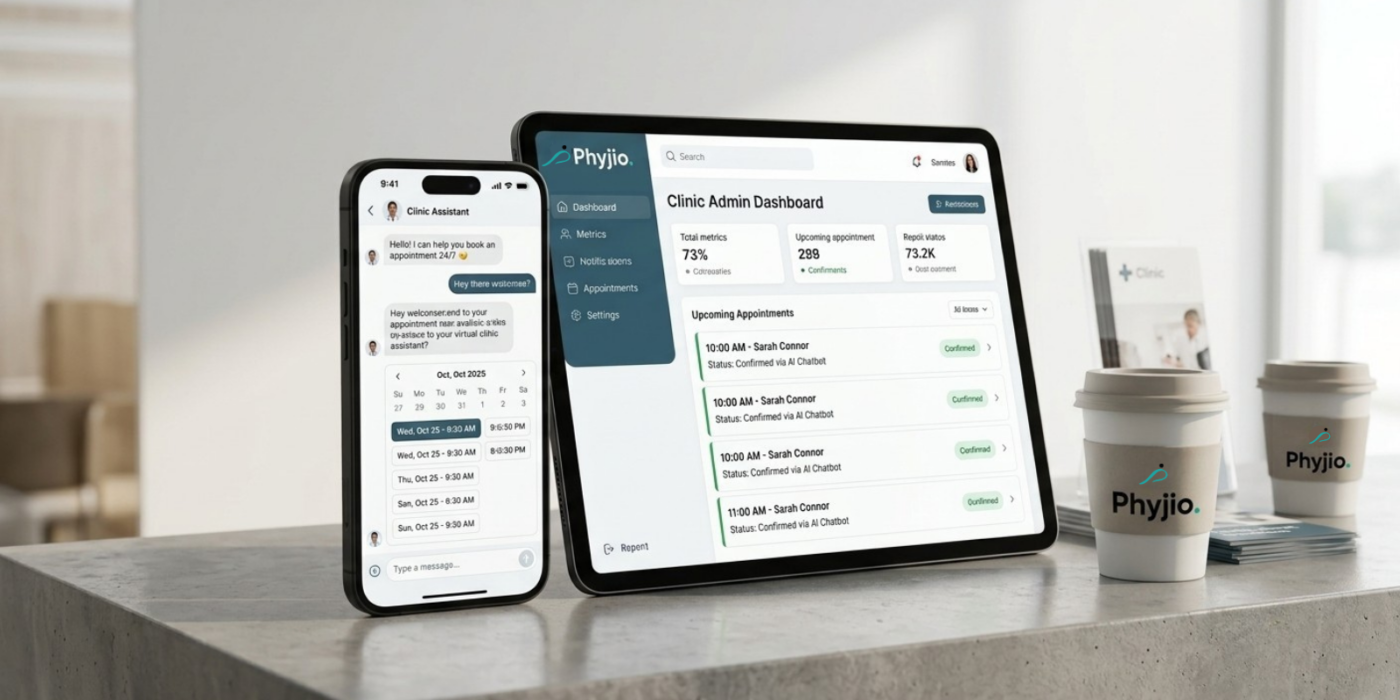
AI Chatbots for Clinics: Handling Appointment Booking and FAQs 24/7
What is an AI chatbot for clinics?
An AI chatbot for clinics is a conversational software application powered by Natural Language Processing (NLP) and Generative AI that automates patient communication. It acts as an AI virtual receptionist, integrating directly with Electronic Medical Records (EMR) and Practice Management Software to handle real-time appointment scheduling, answer medical FAQs, and provide 24/7 patient support across websites, WhatsApp, SMS, and social channels without requiring human intervention.
TL;DR Summary
For busy medical practices, managing front-desk operations is a constant balancing act. Implementing a healthcare chatbot offers an immediate remedy to administrative fatigue.
-
What they do: Automate patient triage, manage calendar synchronization for bookings, and answer repetitive administrative questions.
-
Who should use them: Medical practices, dental offices, physiotherapy clinics, and specialized healthcare centers facing high call volumes.
-
Key benefits: Elimination of missed after-hours calls, zero front-desk long hold times, and friction-free patient intake.
-
Expected ROI: Up to a 30% reduction in operational overhead and a 20% increase in slot utilization through automated appointment reminders and instant lead capture.
What Are AI Chatbots for Clinics?
An AI clinic assistant is far more than a rigid, button-based script. Modern healthcare conversational AI utilizes Large Large Models (LLMs) like GPT-4, Claude, or Gemini to comprehend context, intent, and nuance in patient inquiries.
Rule-Based Chatbots vs. Conversational AI Chatbots
Unlike legacy software that breaks when a user types outside a predetermined script, generative AI systems adapt dynamically to natural human language.
|
Feature |
Rule-Based Chatbots |
Conversational AI Chatbots |
|
Technology Used |
If/Then decision trees |
NLP, Machine Learning, Generative AI |
|
Input Understanding |
Strict keyword matching |
Semantic meaning and user intent |
|
Flexibility |
Rigid; fails on typos or complex phrasing |
Highly flexible; handles conversational shifts |
|
Context Retention |
Clears after every step |
Maintains context throughout the dialogue |
|
Integration Depth |
Basic contact forms |
Deep EMR, CRM, and calendar sync |
How AI Chatbots Handle Appointment Booking
The primary value proposition of an AI chatbot for appointment scheduling lies in its ability to execute end-to-end booking workflows seamlessly. Instead of forcing a patient to navigate an intricate, multi-step web portal, the chatbot handles the process conversationally.
[Patient Request] ➔ [AI Checks EMR/Calendar] ➔ [Presents Real-Time Slots] ➔ [Patient Selects Slot] ➔ [AI Writes to EMR & Triggers SMS/Email Confirmation]
The Autonomous Scheduling Workflow
-
Real-Time Availability Checking: The clinic appointment chatbot interfaces with your Practice Management Software via secure APIs, scanning live physician schedules.
-
Dynamic Slot Presentation: The AI filters open slots based on the appointment type (e.g., initial consultation vs. follow-up) and displays them to the user.
-
Instant Database Registration: Once a time is selected, the bot writes the patient data directly into the Electronic Medical Records (EMR), blocking the slot instantly to avoid double-booking.
-
Omnichannel Confirmation & Sync: The system dispatches immediate text messages or email notifications alongside calendar invites containing direct links for future rescheduling or cancellations.
Expert Tip: Enable your chatbot to detect high-value insurance networks during the booking flow. By qualifying patient insurance coverage inside the chat window, you eliminate downstream billing friction before the patient ever steps foot in the clinic.
How AI Chatbots Answer Patient FAQs
Front-desk staff spend hours every day answering identical operational questions. A clinic FAQ chatbot offloads this burden entirely by serving as an instant knowledge base repository.
Common Administrative Inquiries Handled by AI:
-
Clinic Timings & Operations: “Are you open on Saturdays?” or “What are your holiday hours?”
-
Location & Directions: Providing precise addresses, parking garage availability, or public transit directions.
-
Insurance & Payments: Verifying accepted PPO/HMO networks, self-pay rates, and copay policies.
-
Preparation Protocols: Detailing pre-appointment guidelines such as fasting requirements for blood panels or filling out preliminary paperwork.
By addressing these queries instantly, the chatbot acts as a medical appointment scheduling software catalyst, converting casual website visitors into confirmed appointments.
Core Features of Healthcare AI Chatbots
To succeed in a modern clinical environment, a medical chatbot must feature more than an intuitive chat box. It requires a robust technological framework engineered for enterprise healthcare operations.
-
Intelligent Conversations: Deciphering colloquial descriptions of symptoms or needs to guide patients to the correct specialty.
-
Omnichannel Communication: Operating uniformly across your website chatbot, WhatsApp integration, Facebook Messenger, and SMS.
-
Live Chat Handoff: Recognizing when an inquiry is highly complex or clinically sensitive and routing the conversation seamlessly to a human receptionist.
-
Multilingual Support: Conversing fluently in dozens of languages to remove accessibility barriers for diverse patient bases.
-
Voice AI Receptionist Capabilities: Processing natural speech over standard phone lines for older demographics who prefer calling over texting.
Benefits of AI Chatbots for Clinics
Implementing an AI front desk software solution drives distinct, quantifiable value across the entire healthcare ecosystem.
For the Clinic and Operations
-
Reduced Administrative Workload: Frees up front-office personnel to focus on in-person patient check-ins and complex medical billing codes.
-
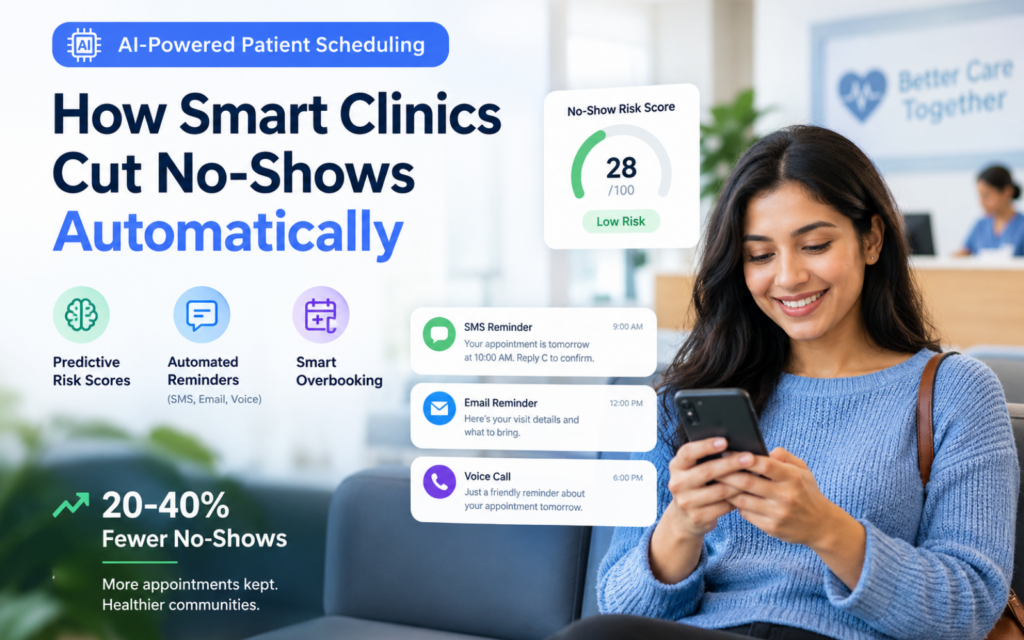
Minimized No-Shows: Employs automated appointment reminders that prompt patients to confirm or reschedule ahead of time, maintaining optimized provider utilization rates.
-
Enhanced Lead Qualification: Identifies new patients out of hours, ensuring inquiries don’t drop off to competing practices.
For Therapists and Clinicians
-
Better Prepared Patients: Ensures intake forms, insurance cards, and medical histories are fully uploaded via the chatbot before the patient arrives.
-
Uninterrupted Workflows: Fewer internal operational interruptions from administrative staff trying to fit urgent walk-ins into an unmanaged calendar.
For the Patients
-
Immediate 24/7 Availability: No more waiting on hold during peak morning hours or dealing with voicemail boxes over weekends.
-
Frictionless Control: The ability to change, cancel, or rebook appointments at midnight from a mobile phone interface.
AI Chatbot vs. Human Receptionist
While AI cannot replace human empathy, it significantly outpaces manual human labor across structured administrative tasks.
|
Performance Metric |
Human Receptionist |
AI Virtual Receptionist |
|
Availability |
Limited to standard business hours |
24/7/365 continuous operation |
|
Response Speed |
Varies by call volume (minutes to hours) |
Instantaneous (< 2 seconds) |
|
Scalability |
Can handle one call or person at a time |
Handles hundreds of concurrent chats |
|
Multilingual Capabilities |
Limited to spoken languages of staff |
Dozens of languages handled natively |
|
Cost Efficiency |
High hourly wages, benefits, overhead |
Flat monthly SaaS or per-interaction pricing |
|
Accuracy in Repetition |
Subject to fatigue and human oversight |
100% consistent with database records |
AI Chatbot vs. Traditional Online Booking Forms
Many practices rely on static online web forms. While functional, forms often experience severe drop-off rates due to cognitive friction.
-
Engagement Dynamics: Traditional web forms feel transactional and rigid. An AI patient engagement chatbot feels like an interactive conversation, answering questions mid-process to keep the patient engaged.
-
Handling Interruptions: If a patient is confused by a field on a static form, they abandon the page. A chatbot answers the point-of-confusion instantly (e.g., “Where do I find my member ID?”) and guides them to completion.
-
Conversion Optimization: Conversational interfaces convert cold traffic up to 40% more effectively than traditional, multi-page web forms.
How AI Chatbots Integrate with Clinic Software
An isolated chatbot creates data silos. To achieve maximum efficiency, the conversational layer must integrate with your existing technology stack.
[Patient Chat Interaction]
       │
       ├──> [EMR / Practice Management Software] (Syncs patient charts & schedule availability)
       ├──> [CRM Platform] (Tracks patient lifecycle & acquisition source)
       └──> [Payment Gateway] (Secures booking deposit via Stripe/PayPal)
-
EMR and Practice Management Systems: Deep API connections with platforms like Epic, Cerner, Athenahealth, or Jane App ensure real-time scheduling alignment.
-
Customer Relationship Management (CRM): Captures new leads and matches incoming phone numbers or WhatsApp profiles to existing patient cards.
-
Payment Gateways: Securely processes copays, consultation down payments, or cancellation fees through PCI-compliant providers during the text conversation.
Common Problems AI Chatbots Solve
-
The Monday Morning Call Bottleneck: Instead of the staff walking into dozens of angry voicemails and a ringing phone line, the AI manages weekend requests over the weekend, leaving Monday mornings peaceful.
-
After-Hours Leakage: Up to 40% of patient search intent occurs outside the typical 9-to-5 window. If a clinic is closed, patients simply click the next listing on Google. A 24/7 chatbot secures those bookings instantly.
-
High Attrition in Specialized Practices: In practices like a chatbot for physiotherapy clinic or chiropractic center, prompt engagement determines where a patient schedules their care. Immediate chat confirmation stops them from shopping around.
Security and Healthcare Compliance
When handling Protected Health Information (PHI), security is paramount. A medical AI system must adhere to stringent national data guidelines.
Crucial Compliance Benchmarks
-
HIPAA Compliance: The software must sign a Business Associate Agreement (BAA), ensuring all handled text, name, and health info data matches the Health Insurance Portability and Accountability Act guidelines.
-
End-to-End Encryption: Data must be encrypted both in transit (AES-256) and at rest within the cloud storage infrastructure.
-
Patient Consent Guardrails: Before initiating any intake collection, the system must prompt the user to consent to electronic communication policies.
-
Detailed Audit Logs: Tracking exactly who, when, and what data interacted with the EMR to ensure compliance clarity during regulatory reviews.
How to Choose the Best AI Chatbot for Your Clinic
Use this practical checklist to evaluate conversational AI vendors for your practice:
-
BAA Signing: Will the vendor sign a definitive Business Associate Agreement for HIPAA compliance?
-
Direct Integration: Does it connect natively to your current medical appointment scheduling software or EMR without complex middleware?
-
Omnichannel Flexibility: Can it handle SMS, web chat, and WhatsApp integration smoothly under one dashboard?
-
Live Handoff Protocols: Is there an easy agent dashboard for your staff to intercept the AI when a human touch is needed?
-
Analytics & Reporting: Does it track operational KPIs, booking completion metrics, and drop-off points?
Best Practices for Implementation
To maximize your software investment, roll out your AI chatbot systematically:
-
Map Your Current Patient Journey: Identify the top 20 questions your front desk answers daily and use those as the baseline training data for the LLM.
-
Establish Clear Escalation Triggers: Program the AI to instantly hand off conversations to a human if terms like “emergency,” “severe pain,” or “chest tightness” are identified.
-
Phased Rollout Strategy: Launch the conversational assistant on your main website for basic FAQs first, then gradually activate EMR-linked scheduling features after reviewing initial transcripts.
-
Train Your Existing Team: Educate your receptionists on how to monitor the AI dashboard so they treat the system as a supportive digital peer rather than a competitor.
Future Trends in Clinic Automation
The trajectory of clinical AI points toward completely autonomous front-office management.
-
Advanced Voice AI Assistants: Phone bots capable of processing speech inflections, eliminating traditional mechanical interactive voice response (IVR) phone menus entirely.
-
Predictive Patient Triage: Chatbots utilizing clinical algorithms to assess symptom severity and automatically match patients with the optimal level of medical urgency.
-
Wearable Integration Diagnostics: Emerging integrations allow bots to sync with wearable health data prior to check-in, providing doctors with automated patient vital updates ahead of the appointment.
People Also Ask (PAA) Answer Blocks
Are AI chatbots safe for healthcare clinics?
Yes, AI chatbots are safe for clinics provided they are built on specialized, healthcare compliance architectures that sign BAAs, secure data through encryption, and do not provide unauthorized formal medical diagnostic advice.
Can AI chatbots replace human clinic receptionists?
No, AI chatbots do not replace human receptionists; instead, they act as an AI clinic assistant. They automate tedious, repetitive, high-volume tasks like booking appointments and giving directions, allowing human staff to focus on complex, high-empathy in-clinic patient care.
Do AI chatbots work on WhatsApp for medical booking?
Yes, conversational AI platforms offer robust WhatsApp integration, allowing patients to securely check physician availability, confirm appointment slots, and receive automated reminders inside their favorite messaging app.
Frequently Asked Questions (FAQ)
1. How does a clinic AI chatbot handle a medical emergency?
The chatbot is pre-programmed to identify critical medical keywords. If a patient mentions life-threatening symptoms, the AI halts the booking flow instantly, presents emergency phone lines, and instructs the individual to dial 911 or visit the nearest emergency room immediately.
2. Can the chatbot prevent double-bookings on our calendar?
Yes. Because the chatbot relies on real-time calendar synchronization with your EMR or clinic management software, it checks live slot availability milliseconds before presenting options to a patient, preventing any potential booking overlaps.
3. What happens if a patient asks a question the AI doesn’t know?
When encountering an unfamiliar query, the chatbot leverages a live chat handoff protocol. It politely informs the patient that it is transferring the query to a clinic staff member, routing the entire chat transcript to your team’s internal dashboard for a follow-up.
4. How long does it take to implement an AI chatbot into a medical practice?
Basic website FAQ configurations can be deployed within a few days. Deep integrations that involve custom EMR writing capabilities, calendar synchronization, and omnichannel workflows typically take between two to four weeks depending on the software architecture.
5. Can an AI chatbot help reduce our clinic’s appointment no-show rates?
Absolutely. By sending out timely, interactive, automated appointment reminders via SMS or WhatsApp, the chatbot allows patients to seamlessly confirm, cancel, or click to reschedule in real time, drastically reducing open slots.
6. Is patient data shared with open-source public AI models?
No. Enterprise-grade healthcare chatbots leverage isolated, private API instances where patient data is hidden, protected, and completely excluded from public LLM training datasets to ensure total data privacy.
7. Can the chatbot handle co-pays or deposits during scheduling?
Yes, through secure integrations with PCI-compliant payment gateways like Stripe or PayPal, the chatbot can require a booking deposit or co-pay processing before locking down the chosen time slot in the calendar.
8. Is an AI chatbot suitable for small specialty clinics, like physical therapy?
Yes, specialized offices such as a chatbot for physiotherapy clinic benefit heavily, as they often lack dedicated, full-time administrative staff to capture every inbound phone call or web inquiry instantly.
9. Does the chatbot support voice-to-text messaging?
Yes, modern conversational AI interfaces allow patients to tap their microphone, speak naturally, and have their spoken questions processed accurately by the underlying NLP software engine.
10. Can the AI distinguish between new patients and returning patients?
Yes. By integrating with your CRM and EMR systems, the chatbot can ask for a phone number or email, cross-reference your database, and customize the booking or intake workflow based on their patient status.
Conclusion
Transitioning to an AI chatbot for clinics is no longer a futuristic luxury—it is a foundational operational strategy for modern medical practices. By offering 24/7 appointment booking and automated FAQ management, clinics can simultaneously lower front-desk stress, stop lead leakage, and improve the overall patient experience. Embrace healthcare conversational AI today to turn your clinic’s digital front door into a highly optimized, compliant, and continuously available operation.