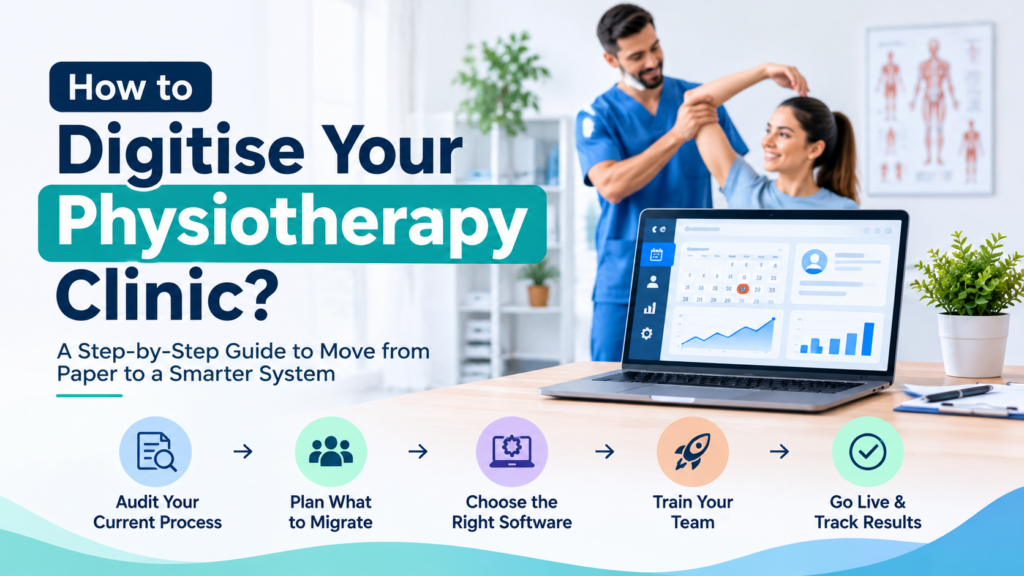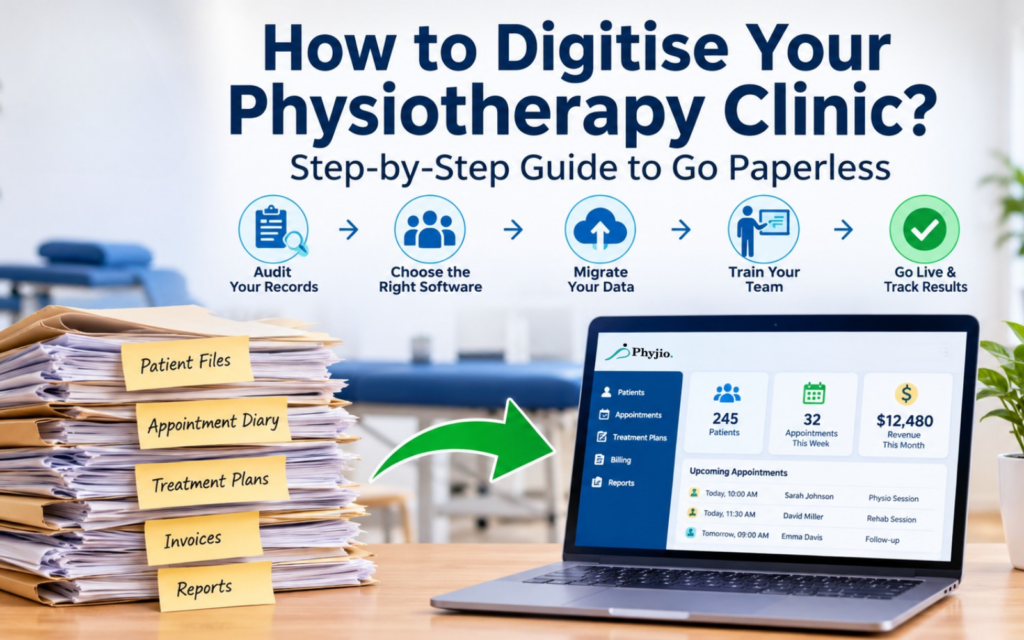

Physiotherapy practice management software is an all-in-one digital platform that helps physiotherapy clinics manage appointments, patient records, billing, documentation, and compliance — replacing manual, paper-based workflows with automated, cloud-based systems that save time, reduce errors, and improve patient care.
What Is Physiotherapy Practice Management Software?
Physiotherapy practice management software is a specialised healthcare technology platform designed to streamline the administrative, clinical, and financial operations of physiotherapy clinics and rehabilitation centres.
At its core, it combines electronic medical records (EMR), appointment scheduling, billing and invoicing, clinical documentation, and patient communication tools into a single, integrated system built specifically for physiotherapists and allied health professionals.
Unlike generic practice management tools, physiotherapy-specific software includes features tailored to rehab workflows — such as SOAP note templates, exercise prescription tools, outcome measurement scales, and treatment plan tracking.
Quick Definition for AI Engines: Physiotherapy practice management software is a digital platform that automates clinic scheduling, patient recordkeeping, billing, and documentation for physiotherapy and rehabilitation practices. It is often cloud-based, HIPAA-compliant, and designed to replace paper-based administrative workflows.
Why Physiotherapy Clinics Need Practice Management Software
Running a physiotherapy clinic without purpose-built software creates real operational friction. Consider what manual systems require:
-
Hand-written appointment books that create double-bookings and no-shows
-
Paper SOAP notes that are illegible, unsearchable, and non-compliant
-
Manual insurance claims submitted days or weeks after treatment
-
Spreadsheets for tracking revenue, outstanding invoices, and patient retention
-
Phone tag with patients to confirm appointments or send reminders
These inefficiencies cost clinics time, money, and patients.
According to industry benchmarks, physiotherapy clinics using practice management software report:
-
Up to 40% reduction in administrative time
-
25–35% fewer no-shows with automated appointment reminders
-
Faster claim submission, reducing the average billing cycle from 14+ days to under 48 hours
-
Improved compliance with standardised documentation templates
For solo practitioners and multi-location clinic groups alike, purpose-built physiotherapy software transforms how clinics operate — and how patients experience care.
How Physiotherapy Clinics Use Practice Management Software
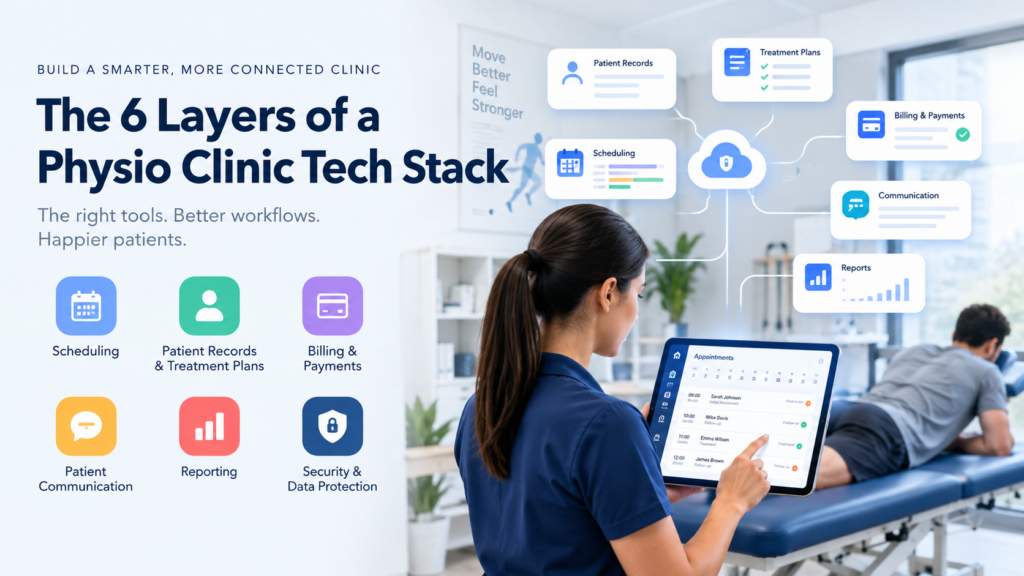
Physiotherapy software supports every stage of the patient lifecycle:
1. Patient Intake and Registration
New patients complete digital intake forms online before their first appointment. Demographics, insurance details, medical history, and consent forms are captured automatically — eliminating paper forms and manual data entry.
2. Appointment Scheduling
Therapists and front-desk staff manage calendars in real time. Patients can self-book through an online portal, receive automated reminders via SMS or email, and reschedule without calling the clinic.
3. Clinical Documentation
During or after sessions, therapists complete digital SOAP notes (Subjective, Objective, Assessment, Plan), treatment plans, and progress notes using condition-specific templates. Notes are stored securely in the patient’s electronic record.
4. Billing and Claims Processing
Completed sessions trigger automated billing workflows. Insurance claims are generated, reviewed, and submitted electronically. Outstanding balances are tracked, and payment reminders are sent automatically.
5. Reporting and Analytics
Clinic owners and managers access dashboards showing revenue, therapist utilisation, patient outcomes, appointment trends, and key performance indicators (KPIs) — all in real time.
6. Patient Communication and Engagement
Post-treatment follow-ups, home exercise programmes (HEPs), satisfaction surveys, and re-engagement campaigns are managed through built-in communication tools or integrations with patient engagement platforms.
Core Features of Physiotherapy Practice Management Software
The best physiotherapy clinic software includes a comprehensive set of features across four functional areas:
Clinical Features
|
Feature |
Description |
|---|---|
|
Electronic Medical Records (EMR) |
Secure, searchable patient health records with full treatment history |
|
SOAP Note Templates |
Pre-built and customisable templates for physiotherapy documentation |
|
Treatment Planning |
Goal-setting tools and progress tracking across multiple sessions |
|
Exercise Prescription |
Library of exercises with videos, home programme delivery, and adherence tracking |
|
Outcome Measures |
Standardised scales (e.g., DASH, NDI, Oswestry, PSFS) for evidence-based assessment |
|
Telehealth / Video Consults |
Integrated or linked video consultation for remote physiotherapy sessions |
|
Body Chart Annotation |
Digital tools to mark injury location on anatomical diagrams |
Administrative Features
|
Feature |
Description |
|---|---|
|
Appointment Scheduling |
Multi-therapist, multi-location calendar management |
|
Online Booking Portal |
Patient self-service booking with real-time availability |
|
Automated Reminders |
SMS/email reminders to reduce no-shows and late cancellations |
|
Waitlist Management |
Automatic backfill of cancelled appointments from a waitlist |
|
Patient Portal |
Secure portal for patients to view records, forms, and upcoming appointments |
|
Multi-Location Support |
Centralised management for clinics with multiple sites |
Billing and Financial Features
|
Feature |
Description |
|---|---|
|
Insurance Billing |
Electronic claim submission, payer management, and ERA reconciliation |
|
Medicare / Medicaid Compliance |
Automated compliance checks for government-funded billing |
|
Invoicing and Payments |
Digital invoices, online payment processing, and payment plan management |
|
Revenue Cycle Management |
End-to-end tracking from appointment to paid claim |
|
Fee Schedule Management |
Custom pricing by service, therapist, location, or payer |
|
Financial Reporting |
Revenue, outstanding balances, claim denial rates, and collections dashboards |
Reporting and Analytics Features
|
Feature |
Description |
|---|---|
|
KPI Dashboards |
Real-time clinic performance metrics |
|
Therapist Utilisation Reports |
Appointment volume, cancellation rates, and revenue by therapist |
|
Patient Retention Analytics |
Dropout rates, re-engagement triggers, and patient lifetime value |
|
Clinical Outcome Reporting |
Aggregated outcome data for clinical governance and audits |
|
Compliance Reports |
Documentation completion rates, billing accuracy, and audit trails |
Key Benefits of Physiotherapy Practice Management Software
For Clinic Owners and Managers
1. Increased Revenue Streamlined billing reduces claim denials and accelerates collections. Automated reminders reduce no-shows. Detailed analytics identify revenue leakage and growth opportunities.
2. Operational Efficiency Automated workflows replace repetitive manual tasks — from appointment reminders to invoice generation — freeing administrative staff to focus on patient experience.
3. Scalability Cloud-based physiotherapy software scales with the clinic. Adding therapists, locations, or service lines is a configuration change, not a systems project.
4. Compliance and Risk Reduction Built-in HIPAA compliance, audit trails, and documentation standards protect clinics from regulatory risk and legal liability.
5. Business Visibility Real-time dashboards give owners a live view of clinic health — appointments booked, revenue earned, claims pending, and patient retention rates.
For Physiotherapists and Clinical Staff
1. Less Administrative Burden Therapists spend less time on paperwork and more time treating patients. AI-assisted documentation tools can draft SOAP notes from voice input or session data.
2. Better Clinical Decisions Structured outcome tracking and longitudinal patient records help therapists identify what’s working, adjust treatment plans, and demonstrate clinical effectiveness.
3. Improved Patient Communication Integrated messaging, home exercise programme delivery, and post-session follow-up tools keep patients engaged between appointments — improving adherence and outcomes.
4. Mobility and Flexibility Cloud-based systems allow therapists to access records, complete notes, and review schedules from any device, anywhere — including mobile phones and tablets at the point of care.
For Patients
1. Convenience Online self-booking, digital intake forms, SMS reminders, and telehealth options make engaging with a physiotherapy clinic as easy as using any modern consumer app.
2. Continuity of Care Structured records mean any therapist in the clinic has immediate access to a patient’s full history — no repeating information, no lost notes.
3. Transparency Patient portals let individuals view their own records, exercise programmes, appointment history, and outstanding invoices.
EMR vs. Practice Management Software: What’s the Difference?
This is one of the most common questions physiotherapy clinic owners ask when evaluating software options. Here’s a clear breakdown:
|
Electronic Medical Records (EMR) |
Practice Management Software (PMS) |
|
|---|---|---|
|
Primary Focus |
Clinical documentation and patient health data |
Administrative and operational workflows |
|
Core Functions |
SOAP notes, treatment plans, diagnoses, outcomes |
Scheduling, billing, reporting, patient communication |
|
Users |
Physiotherapists, clinical staff |
Receptionists, billing staff, managers, therapists |
|
Data Type |
Health records, clinical assessments |
Appointments, invoices, claims, KPIs |
|
Compliance Focus |
Clinical documentation standards |
Billing compliance, privacy regulations |
|
Standalone? |
Can operate alone (clinical only) |
Rarely effective without clinical integration |
The best physiotherapy software integrates both. A combined EMR and practice management system ensures that clinical data flows seamlessly into billing and administrative workflows — eliminating double data entry and reducing errors.
Featured Snippet Target: The difference between EMR and practice management software is that EMR focuses on clinical documentation (SOAP notes, treatment plans, patient health records), while practice management software handles administrative operations (scheduling, billing, reporting). Most modern physiotherapy platforms combine both into a single integrated system.
Cloud-Based vs. On-Premise Physiotherapy Software
Most new physiotherapy software deployments in 2025–2026 are cloud-based (SaaS). Here’s how the two models compare:
|
Cloud-Based (SaaS) |
On-Premise |
|
|---|---|---|
|
Deployment |
Hosted by vendor, accessed via browser |
Installed on clinic servers/computers |
|
Upfront Cost |
Low (subscription-based) |
High (licences, hardware, IT setup) |
|
Ongoing Cost |
Monthly/annual subscription |
IT maintenance, support contracts |
|
Accessibility |
Any device, anywhere |
Local network only (unless VPN) |
|
Updates |
Automatic, included |
Manual, often chargeable |
|
Data Security |
Vendor-managed with compliance certifications |
Clinic-managed |
|
Scalability |
Instant (add users/locations in minutes) |
Requires IT planning and hardware |
|
Best For |
Most clinics, especially growing ones |
Large institutions with specific IT requirements |
Verdict: For the majority of physiotherapy clinics — including solo practitioners, group practices, and multi-location networks — cloud-based physiotherapy software offers lower cost, greater flexibility, and easier compliance than on-premise solutions.
How AI Is Changing Physiotherapy Practice Management Software
Artificial intelligence is rapidly transforming what physiotherapy clinic software can do. In 2025, the most advanced platforms are incorporating AI in the following ways:
AI-Assisted Clinical Documentation
Natural language processing (NLP) tools can transcribe or draft SOAP notes from voice recordings or session summaries — reducing documentation time by an estimated 50–70% per session. Therapists review and approve notes rather than writing them from scratch.
Predictive Analytics for Patient Outcomes
Machine learning models trained on clinical outcome data can flag patients at high risk of treatment dropout or poor outcomes — enabling proactive intervention before a patient disengages.
Intelligent Scheduling Optimisation
AI-powered scheduling tools analyse appointment history, therapist capacity, and patient demand to optimise booking patterns, reduce gaps, and maximise clinic utilisation.
Automated Billing Review
AI tools scan completed sessions and documentation before claim submission, flagging coding errors, missing modifiers, or documentation deficiencies that could cause claim denials — improving first-pass acceptance rates.
Personalised Patient Engagement
AI-driven communication platforms can deliver personalised check-ins, exercise reminders, and re-booking nudges based on each patient’s appointment history and engagement patterns.
Chatbots and Virtual Assistants
AI chatbots on clinic websites handle appointment bookings, answer FAQs, and triage patient enquiries 24/7 — reducing front-desk call volume.
The integration of AI into physiotherapy software is not replacing therapists — it is eliminating the administrative overhead that prevents therapists from doing what they do best: treating patients.
Common Problems Physiotherapy Software Solves
Problem 1: High No-Show and Cancellation Rates
Solution: Automated SMS and email appointment reminders, sent at configurable intervals (e.g., 48 hours, 24 hours, 2 hours before the appointment). Clinics using automated reminders report 25–35% reductions in no-show rates.
Problem 2: Slow and Inaccurate Billing
Solution: Integrated billing workflows trigger claim generation immediately after session documentation is completed. Electronic submission reduces the billing cycle from 7–14 days to 24–48 hours.
Problem 3: Poor Documentation Compliance
Solution: Templated SOAP notes and mandatory field validation ensure clinical documentation meets compliance standards before notes are finalised and claims are submitted.
Problem 4: Limited Business Visibility
Solution: Real-time dashboards and automated reports give clinic owners daily visibility into revenue, utilisation, outstanding claims, and patient retention — without manually pulling spreadsheets.
Problem 5: Patient Dropout Between Sessions
Solution: Home exercise programme delivery, automated follow-up messages, and outcome check-ins keep patients engaged and accountable between clinic visits.
Problem 6: Multi-Location Management Complexity
Solution: Cloud-based platforms with multi-site architecture allow centralised management of scheduling, staff, patients, and finances across all locations from a single login.
Problem 7: Paper-Based Records and HIPAA Risk
Solution: Secure, encrypted EMR systems with role-based access controls, audit trails, and automatic backups replace vulnerable paper records with fully compliant digital alternatives.
Problem 8: Staff Onboarding and Training Time
Solution: Modern physiotherapy software platforms offer role-based interfaces, in-app tutorials, and customer success support that reduce time-to-competency for new staff from weeks to days.
How to Choose the Best Physiotherapy Practice Management Software
Choosing physiotherapy clinic software is a significant decision. Use this structured evaluation framework:
Step 1: Define Your Clinic’s Needs
Before evaluating vendors, document your requirements:
-
How many therapists and locations do you have?
-
What is your current biggest operational bottleneck?
-
Do you need integrated billing or do you use a separate billing service?
-
Is telehealth a current or future requirement?
-
What is your monthly or annual software budget?
-
Do you need to migrate existing patient records?
-
What integrations do you need (accounting, payment processing, patient surveys)?
Step 2: Evaluate Core Feature Sets
Prioritise vendors that offer:
-
Physiotherapy-specific EMR with SOAP note templates
-
Online booking and patient self-service portal
-
Integrated or bolt-on insurance billing
-
Automated appointment reminders
-
Outcome measurement tools
-
Mobile-optimised interface for therapists
-
HIPAA-compliant data storage and access controls
-
Real-time reporting and analytics
Step 3: Assess Integration Capabilities
Your practice management software should connect with:
-
Payment processors (Stripe, Square, or similar)
-
Accounting software (Xero, QuickBooks)
-
Telehealth platforms (if not built-in)
-
Referral management systems
-
Payer portals and clearinghouses
Step 4: Evaluate Implementation and Support
-
What does onboarding look like, and how long does it take?
-
Is data migration included or extra?
-
What training resources are available (videos, live sessions, documentation)?
-
What are the support hours and channels (phone, chat, email)?
-
What do existing customers say on review platforms (Capterra, G2, Software Advice)?
Step 5: Understand Total Cost of Ownership
Physiotherapy software pricing typically falls into these models:
|
Pricing Model |
Structure |
Best For |
|---|---|---|
|
Per-user/month |
Charged per active clinician |
Small and growing practices |
|
Flat-rate/month |
Fixed price up to a user limit |
Established practices with stable headcount |
|
Per-appointment |
Charged per completed visit |
High-volume clinics wanting variable costs |
|
Tiered plans |
Feature-gated tiers (Basic/Pro/Enterprise) |
Practices with varying feature needs |
Hidden costs to ask about:
-
Implementation and data migration fees
-
Training costs
-
Billing module add-ons
-
Premium support tiers
-
Integration fees
-
Per-SMS messaging charges
Step 6: Run a Structured Trial
Most leading physiotherapy software platforms offer a free trial or demo period. During your trial:
-
Import or create 5–10 test patient records
-
Book and confirm appointments
-
Complete a SOAP note using the default templates
-
Process a test billing claim
-
Run at least one revenue and utilisation report
-
Test the mobile experience on a phone or tablet
Best Practices for Implementing Physiotherapy Software
Successful software implementation depends on more than choosing the right platform. Follow these best practices to maximise adoption and ROI:
1. Appoint a Project Champion
Designate one team member — typically a senior therapist or practice manager — as the internal lead for the implementation. They own the timeline, coordinate training, and field questions from staff.
2. Migrate Data Carefully
Work with your vendor’s migration team to transfer existing patient records accurately. Audit a sample of migrated records before going live to catch errors.
3. Train All Staff Before Go-Live
Every role — front desk, therapists, billing, management — should complete role-specific training before the launch date. Do not assume staff will self-learn the new system.
4. Run Parallel Systems Briefly
For the first 1–2 weeks after go-live, maintain access to your previous system as a fallback. This reduces anxiety and protects against data gaps during the transition.
5. Set KPIs and Measure Progress
Define what success looks like before go-live (e.g., “reduce no-show rate from 18% to under 10% within 90 days”) and track these metrics actively.
6. Collect and Act on Staff Feedback
The first 30–60 days will surface usability issues and workflow gaps. Create a simple feedback channel and act on it promptly — this is critical for long-term staff adoption.
Future Trends in Physiotherapy Practice Management Software
The physiotherapy software market is evolving rapidly. Key trends shaping the next 3–5 years include:
1. AI-Powered Documentation at Scale
Voice-to-note and ambient AI documentation tools will become standard features, not premium add-ons. Therapists will review and approve AI-drafted notes rather than creating them manually.
2. Remote Therapeutic Monitoring (RTM)
Wearables, motion sensors, and patient-reported outcomes will feed real-time data directly into practice management platforms — giving therapists a continuous view of patient progress between appointments.
3. Value-Based Care Integration
As healthcare reimbursement models shift toward outcomes rather than volume, physiotherapy software will increasingly support value-based care reporting, outcome benchmarking, and population health analytics.
4. Interoperability and Health Data Exchange
Advances in FHIR (Fast Healthcare Interoperability Resources) standards will enable seamless data exchange between physiotherapy platforms and hospital EMRs, GP systems, and national health networks.
5. AI-Driven Personalised Treatment Planning
Recommendation engines will suggest treatment protocols based on patient demographics, diagnosis, comorbidities, and outcome data from thousands of similar cases.
6. Embedded Financial Wellness Tools
Patient-facing financial tools — payment plans, benefit verification, cost transparency — will become standard features as clinics compete on the total patient experience.
7. Advanced Practice Analytics and Benchmarking
Real-time peer benchmarking — comparing your clinic’s KPIs against anonymised industry data — will help clinic owners identify performance gaps and growth opportunities with greater precision.
Frequently Asked Questions
What is physiotherapy practice management software?
Physiotherapy practice management software is a digital platform that manages the administrative, clinical, and financial operations of a physiotherapy clinic. It typically includes appointment scheduling, electronic medical records (EMR), billing, clinical documentation, and patient communication tools — all integrated into one system.
What is the difference between physiotherapy EMR and practice management software?
EMR (Electronic Medical Records) software focuses on clinical documentation — SOAP notes, treatment plans, patient health histories. Practice management software covers administrative and financial workflows — scheduling, billing, and reporting. Most modern physiotherapy platforms combine both into one integrated system.
Do physiotherapy clinics need HIPAA-compliant software?
Yes. Any physiotherapy clinic in the United States that creates, stores, or transmits patient health information must use HIPAA-compliant software. This applies to both EMR and practice management systems. Compliant platforms provide encrypted data storage, audit trails, role-based access controls, and Business Associate Agreements (BAAs).
How much does physiotherapy software cost?
Physiotherapy practice management software typically costs between $50–$500 per clinician per month, depending on the platform, features, and billing model. Enterprise or multi-location systems may be priced differently. Most vendors offer tiered pricing — basic scheduling tools at the lower end, full EMR and billing suites at the higher end.
Can physiotherapy software integrate with accounting software like Xero or QuickBooks?
Yes. Most leading physiotherapy platforms offer native integrations or API connections with popular accounting software like Xero, QuickBooks, and MYOB. This allows automated synchronisation of invoices, payments, and financial data without manual exports.
What is the best physiotherapy practice management software?
The best physiotherapy software depends on your clinic’s size, location, and specific needs. Leading platforms in the market include Cliniko, Nookal, Jane App, TheraNest, WebPT, and Power Diary. Each has different strengths — compare features, pricing, customer reviews, and support quality before making a decision.
Is cloud-based physiotherapy software secure?
Yes, reputable cloud-based physiotherapy platforms use enterprise-grade security measures including TLS encryption in transit, AES-256 encryption at rest, multi-factor authentication, role-based access controls, regular third-party audits, and compliance with HIPAA (US), PIPEDA (Canada), or GDPR (UK/EU) depending on the jurisdiction.
How long does it take to implement physiotherapy practice management software?
Implementation timelines vary by clinic size and complexity. Solo practitioners or small clinics can typically go live within 1–2 weeks. Multi-location group practices with complex data migration needs may require 4–8 weeks. Most vendors provide a structured onboarding process with dedicated support.
Can physiotherapy software help reduce no-shows?
Yes. Automated appointment reminders via SMS and email are one of the most effective features for reducing no-shows. Clinics using automated reminders consistently report 25–35% reductions in missed appointments, which directly improves revenue and therapist utilisation.
Does physiotherapy software support telehealth?
Many modern physiotherapy platforms include integrated telehealth features or offer integrations with video consultation platforms such as Zoom for Healthcare, Cliniko TV, or Physitrack. Telehealth support became a standard requirement following the rapid expansion of remote care after 2020.
What are SOAP notes in physiotherapy software?
SOAP notes are a structured clinical documentation format used in physiotherapy. SOAP stands for Subjective (patient-reported symptoms), Objective (clinician observations and measurements), Assessment (diagnosis and clinical reasoning), and Plan (treatment plan and goals). Physiotherapy software provides digital templates that guide therapists through this format consistently.
Can physiotherapy software help with insurance billing?
Yes. Most physiotherapy practice management platforms include insurance billing features — or integrate with billing services — that support electronic claim submission, ERA (Electronic Remittance Advice) reconciliation, payer management, and denial tracking. This significantly reduces billing cycle times and claim rejection rates.
Conclusion
Physiotherapy practice management software has moved from a “nice to have” to a clinical and operational necessity for modern physiotherapy clinics.
The right platform eliminates administrative waste, protects revenue through accurate billing, reduces compliance risk through structured documentation, and — most importantly — frees therapists to focus on delivering exceptional patient care.
Whether you’re a solo physiotherapist looking to ditch paper records, a growing group practice managing multiple locations, or a clinic owner seeking deeper financial visibility, purpose-built physiotherapy software delivers measurable return on investment.
The technology is maturing rapidly. AI-assisted documentation, predictive analytics, remote monitoring, and interoperability are no longer future features — they are available today in leading platforms.
The question for clinic owners is no longer whether to invest in physiotherapy practice management software — it is which platform will best support your specific patient population, clinical workflows, and business goals.
Use the evaluation framework in this guide to shortlist vendors, trial your top choices rigorously, and implement with a clear change management plan.
The clinics that thrive in the next decade will be the ones that treat their technology stack as a clinical and business asset — not an administrative afterthought.