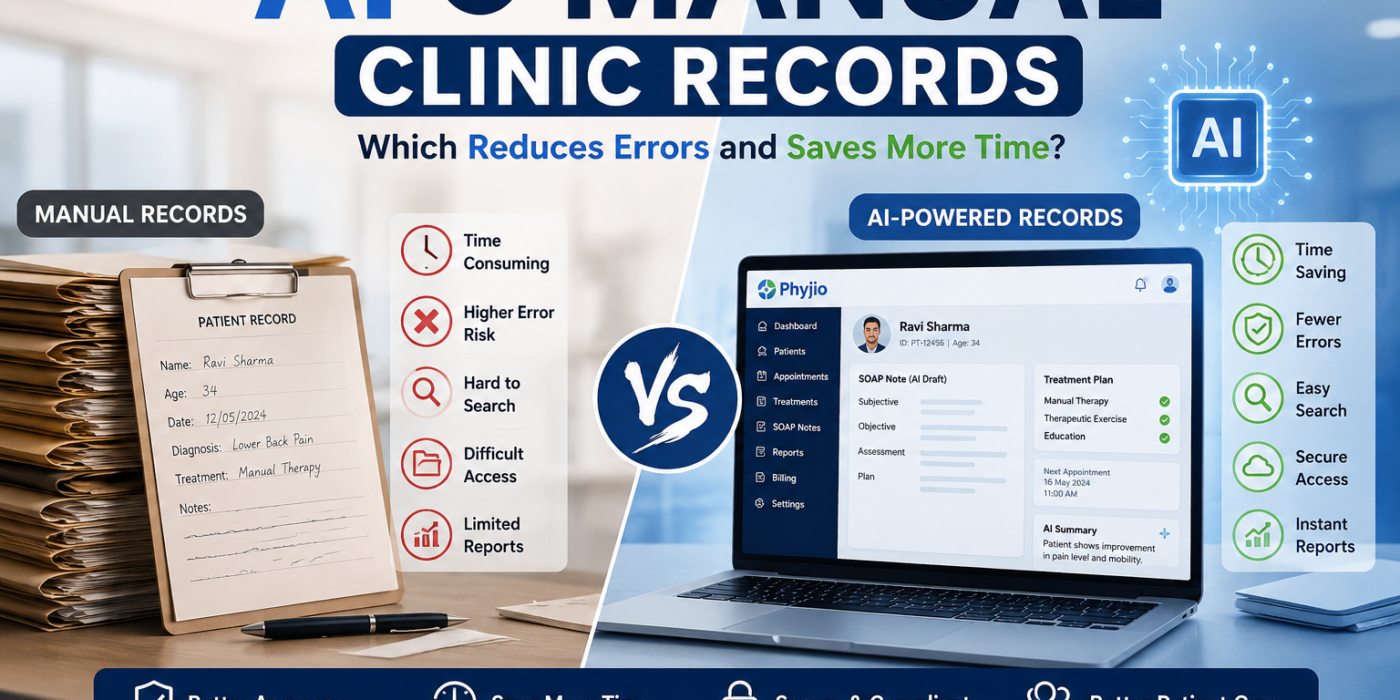
AI-assisted digital clinic records generally have greater potential to reduce repetitive data-entry errors and save administrative time than manual, paper-based records—but they do not eliminate errors. Human review, proper workflows, staff training, and secure software remain essential. AI works best as an assistant to physiotherapists and clinic staff, not a replacement for their clinical judgment.
TL;DR
-
Manual records involve more repetitive, manual data entry and are harder to search.
-
Digital records improve accessibility, backup, and reporting.
-
AI can automate documentation tasks like SOAP note drafting and summaries.
-
AI-generated content must always be reviewed by a qualified professional.
-
Digital systems typically offer better audit trails and access controls.
-
The biggest time savings usually come from workflow automation, not AI alone.
-
AI is an assistant, not a replacement, for healthcare professionals.
What Are Manual Clinic Records?
Manual clinic records are paper-based patient files: handwritten notes, physical appointment registers, printed treatment plans, and manual billing ledgers. Data is entered by hand and stored in physical filing systems.
|
Aspect |
Manual Records |
|---|---|
|
Data entry |
Manual |
|
Searchability |
Limited |
|
Accessibility |
Physical file dependent |
|
Error risk |
Higher with repetitive entry |
|
Documentation speed |
Slower |
|
Sharing |
Difficult |
|
Backup |
Manual |
|
Reporting |
Time-consuming |
|
Automation |
Very limited |
|
Audit trail |
Often limited |
Not every manual system is inaccurate—many well-run small clinics maintain excellent paper records. But as patient volume grows, manual processes become harder to sustain.
What Are AI-Powered Clinic Records?
AI-powered clinic records are digital systems that use AI to assist with documentation, data organization, note generation, voice-to-text workflows, reminders, and reporting.
It’s important to separate two things:
-
AI-assisted documentation: AI helps draft notes, summarize history, or organize information—always reviewed by the clinician.
-
AI making clinical decisions: AI independently deciding diagnosis or treatment. This is not what responsible clinic software does. AI should support professional judgment, not replace it.
AI vs Manual Clinic Records: Key Differences
|
Factor |
Manual Records |
Digital/AI-Assisted Records |
|---|---|---|
|
Data entry |
Repetitive, manual |
Templates, autofill, AI drafts |
|
Documentation time |
Slower |
Generally faster |
|
Accuracy |
Depends on staff care |
Validation reduces some errors; AI can still err |
|
Searchability |
Poor |
Strong |
|
Accessibility |
Onsite only |
Cloud/remote access |
|
Duplicate data |
Common |
Reduced with validation |
|
Reporting |
Manual compilation |
Automated |
|
Security |
Physical risk |
Encryption, access control (if implemented well) |
|
Audit trails |
Rare |
Standard feature |
|
Scalability |
Poor |
Strong |
|
Human oversight |
Always required |
Still required |
Digital and AI-assisted systems generally outperform manual records on speed, searchability, and scalability—but oversight remains necessary in both.
Which Reduces Documentation Errors?
Data Entry Errors
Repetitive manual entry can cause typos, wrong dates, duplicate records, and missing fields. Digital forms with validation rules can catch many of these before submission.
Documentation Errors
Missing SOAP notes, inconsistent terminology, and incomplete treatment records are common in busy clinics. Templates and required fields—found in most digital systems—reduce (not eliminate) these gaps.
AI-Generated Errors
AI is not error-free. Risks include incorrect transcription, misinterpretation of dictated notes, hallucinated details, and inaccurate summaries. AI-generated clinical content must always be reviewed and approved by a qualified healthcare professional before it becomes part of the patient record.
Which Saves More Time?
AI-assisted digital records generally save more administrative time than manual records when properly implemented and integrated into clinic workflows.
|
Clinic Task |
Manual Process |
Digital/AI-Assisted Process |
Impact |
|---|---|---|---|
|
Registration |
Manual entry |
Digital form |
Lower admin effort |
|
Record retrieval |
Search physical file |
Database search |
Faster |
|
SOAP notes |
Written manually |
Templates/AI draft |
Less typing |
|
Appointments |
Register/calendar |
Automated scheduling |
Less coordination |
|
Follow-ups |
Manual reminders |
Automated reminders |
Less repetitive work |
|
Reports |
Manual compilation |
Automated reports |
Faster |
|
Billing |
Manual calculation |
Automated billing |
Lower effort |
[STATISTIC PLACEHOLDER – VERIFY WITH CURRENT AUTHORITATIVE SOURCE] for exact time-savings figures; avoid unverified percentages.
Where AI Can Save the Most Time in a Physiotherapy Clinic
-
SOAP notes: AI can turn structured or dictated input into a draft note for therapist review.
-
Patient history summaries: Software organizes past visits and relevant notes for quick reference.
-
Appointment automation: Scheduling, rescheduling, reminders, and confirmations run automatically.
-
Treatment documentation: Templates cut repetitive typing across sessions.
-
Admin automation: Billing, receipts, notifications, and reports generate with less manual work.
AI vs Manual Records Across the Physiotherapy Workflow
From registration through discharge, digital and AI-assisted tools can support each stage: intake forms replace paper forms, evaluation templates standardize assessments, AI-assisted SOAP notes speed documentation, automated reminders support follow-up adherence, and digital billing reduces manual invoicing. At every step, though, the therapist reviews and finalizes clinical content.
Common Problems With Manual Clinic Records
Lost or misfiled files, slow retrieval, illegible handwriting, duplicate records, missing information, repetitive entry, manual billing, difficulty generating reports, limited accessibility, poor scalability, and heavy dependency on individual staff members.
Common Problems With AI and Digital Clinic Records
AI hallucinations, transcription mistakes, data privacy concerns, cybersecurity risks, staff resistance, poor implementation, learning curves, integration issues, vendor lock-in, subscription costs, internet dependency for cloud tools, and over-reliance on automation. Mitigation includes staff training, clear AI-review policies, and choosing vendors with strong security practices.
AI Does Not Replace Clinical Judgment
AI is assistive technology. Therapists remain responsible for reviewing every AI-generated note before it’s finalized. Treatment decisions require professional judgment, and patient safety must always come first. Clinics should set clear AI usage policies and handle sensitive health data securely.
Digital Records vs AI Records: What’s the Difference?
Digital records are not automatically AI-powered.
-
Manual/paper records: Physical documentation.
-
Digital clinic records: Electronic records in clinic software, without AI assistance.
-
AI-assisted digital records: Digital records enhanced with AI for documentation, summaries, and workflow automation.
Are AI Clinic Records More Accurate?
AI can reduce repetitive data-entry errors, and templates improve consistency. Validation can catch incomplete fields, and automation reduces manual copying. But AI can also introduce its own errors—so accuracy claims should never be absolute. Human review remains essential regardless of the system used.
How AI Improves Clinic Workflow Automation
Manual workflow: Patient → Reception → Paper form → File → Therapist → Manual notes → Billing → Manual follow-up
Digital/AI-assisted workflow: Patient → Digital registration → Patient record → Appointment → AI-assisted documentation → Billing → Automated follow-up → Analytics
Cost Considerations
Manual records carry hidden costs: paper, printing, storage, staff time, filing, and lost productivity. Digital/AI software costs include subscriptions, setup, training, migration, and infrastructure. Evaluate total cost of ownership (TCO), not just subscription price. ROI typically comes from time saved, reduced admin workload, faster billing, and better operational visibility—avoid relying on unverified ROI percentages.
How to Choose the Best Physiotherapy Clinic Software
Evaluate: patient management, digital records, SOAP notes, treatment planning, scheduling, billing, reporting, patient communication, AI capabilities, data security, user permissions, audit logs, cloud/mobile access, backups, integrations, scalability, support, and pricing. The best software is the one that fits your clinic’s workflow, budget, and security needs—not simply the one with the most features.
Questions to Ask Before Buying AI Clinic Software
-
What AI features are actually included?
-
Can therapists review and edit AI-generated notes?
-
How is patient data protected, and is it encrypted?
-
Are there audit logs and permission controls?
-
Can the clinic export or back up its data?
-
What happens if AI generates incorrect information—is human approval required?
-
What’s the pricing model, including any AI usage fees?
Best Practices for Implementing AI-Assisted Clinic Records
-
Start with one workflow.
-
Digitize existing records carefully.
-
Train staff thoroughly.
-
Set documentation standards and AI usage policies.
-
Require human review of all AI output.
-
Monitor errors and gather staff feedback.
-
Protect patient data and review permissions regularly.
-
Measure time savings and refine workflows continuously.
Future of AI in Physiotherapy and Clinic Management
Emerging areas include voice-based documentation, intelligent patient summaries, predictive analytics, wearable and remote-monitoring integration, and AI-assisted clinical decision support. These are developing capabilities, not established standards—clinics should treat them as future considerations rather than current requirements.
FAQ
What are manual clinic records? Paper-based patient files, handwritten notes, and physical filing systems used to track appointments, treatment, and billing.
What are AI-powered clinic records? Digital record systems that use AI to assist with documentation, summaries, scheduling, and administrative automation, under professional review.
Do AI clinic records eliminate errors? No. AI reduces certain repetitive errors but can introduce its own; human review remains necessary.
Is switching from paper to digital records difficult? It requires planning—data migration, staff training, and workflow adjustment—but most clinics manage the transition in stages.
Are AI clinic records HIPAA compliant? Compliance depends on the specific vendor’s security practices, not the presence of AI itself. Clinics should verify encryption, access controls, and data handling policies with each vendor.
Can small physiotherapy clinics benefit from AI software? Yes, though the benefit often grows with patient volume and administrative workload; very small practices may see more modest gains initially.
What is workflow automation in a clinic? Automating repetitive administrative tasks—scheduling, reminders, billing, reporting—to reduce manual staff effort.
How do audit trails help clinics? They record who accessed or changed a patient record and when, supporting accountability and compliance.
Is voice-to-text documentation accurate? It can speed up note-taking but transcription errors are possible, so drafts should always be reviewed before finalizing.
What should a clinic do if AI generates an incorrect note? The reviewing clinician should correct it before it’s saved to the patient record; clinics should have a clear correction process in place.
Does digital software reduce billing errors? Automated billing calculations can reduce manual math errors, though staff should still verify entries before submission.
How long does it take to implement clinic software? Timelines vary by clinic size and system complexity; phased rollouts starting with one workflow are common.