
AI Tools Every Physiotherapy Clinic Should Know: The Complete Guide
The landscape of physical rehabilitation is undergoing a massive shift. Managing a modern practice requires balancing patient care with an ever-increasing mountain of administrative tasks. Between drafting detailed clinical notes, handling insurance billing, and managing patient retention, physical therapists are facing historic levels of burnout.
According to recent healthcare industry data, clinicians spend upward of [Insert latest healthcare AI adoption statistic, e.g., 30%] of their workday on documentation alone.
Enter artificial intelligence. Today, AI tools for physiotherapy clinics are moving beyond novelty tech into essential operational infrastructure. By automating repetitive backend workflows, AI for physiotherapy allows clinicians to step away from the keyboard and focus entirely on the patient on the table.
This comprehensive guide breaks down the core physiotherapy AI software categories transforming practices today, helping you choose the right tools to drive clinic productivity and improve clinical outcomes.
TL;DR: AI in Physiotherapy at a Glance
Don’t have time for the full breakdown? Here is what your clinic needs to know:
-
What it is: AI physiotherapy software uses machine learning, voice AI, and generative models to automate clinic workflows.
-
Why it matters: It eliminates administrative overload, slashes documentation time by up to 50%, and minimizes billing errors.
-
Key tool categories: Ambient medical scribes, intelligent scheduling assistants, automated billing tools, and computer-vision rehabilitation systems.
-
The bottom line: Implementing AI healthcare tools is no longer about staying ahead of the curve—it is about keeping up with patient expectations for seamless, modern care.
What Are AI Tools for Physiotherapy Clinics?
Featured Snippet Definition: > AI tools for physiotherapy clinics are specialized software applications powered by machine learning, natural language processing (NLP), and computer vision designed to automate clinical documentation, optimize appointment scheduling, streamline revenue cycle management, and assist in patient rehabilitation tracking.
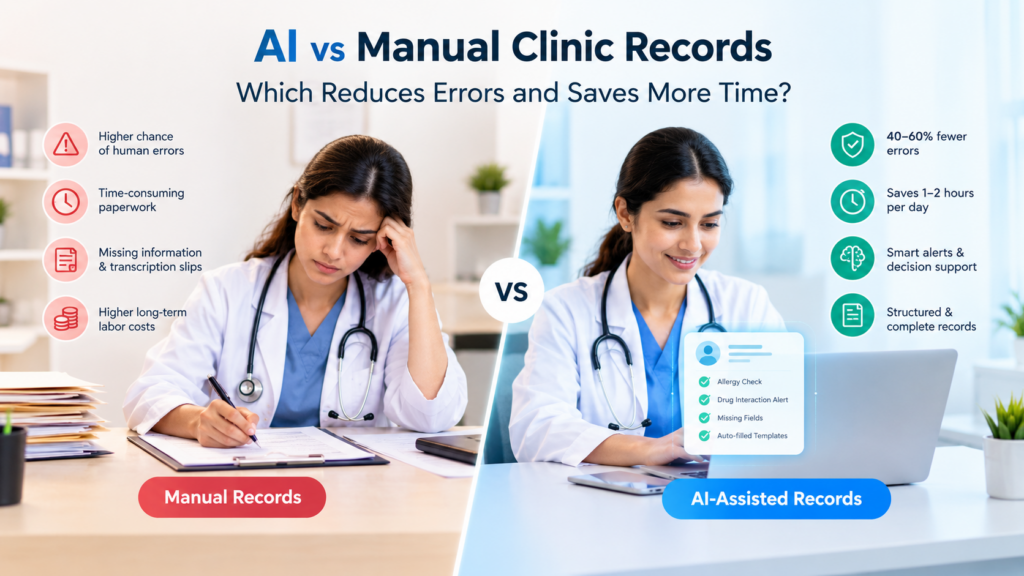
Unlike traditional physiotherapy clinic software that acts as a static digital filing cabinet, AI-powered physiotherapy software is dynamic. Traditional electronic medical records (EMR) systems require manual data entry for every action. AI software, however, analyzes data in real time, learns from clinician patterns, and executes complex cognitive tasks—like turning a conversational patient recording into a structured clinical note.
Common use cases include:
-
Ambient Clinical Intelligence: Capturing dialogue during a treatment session to generate AI SOAP notes.
-
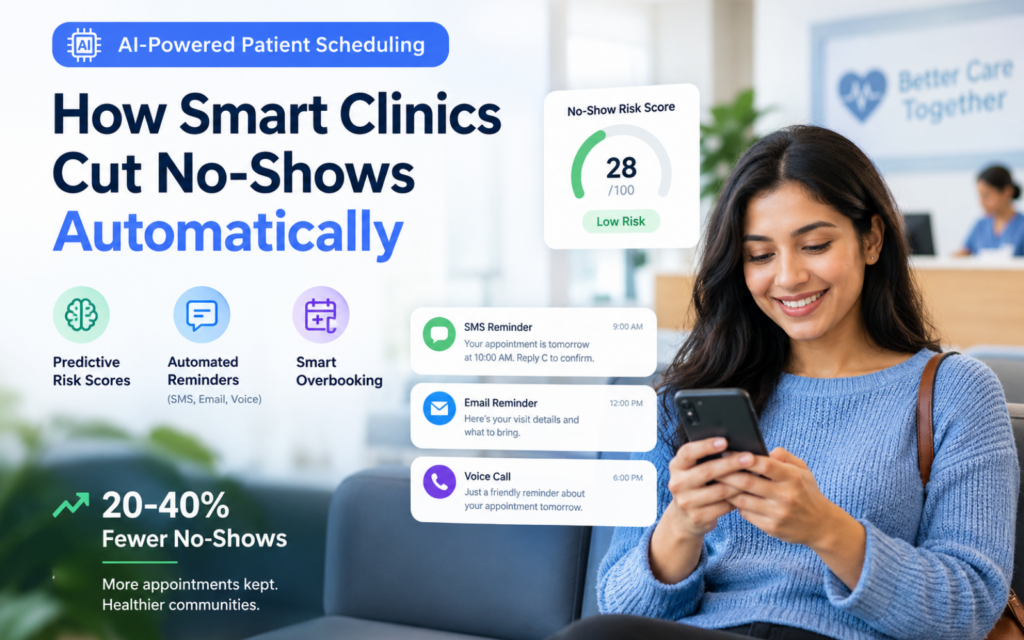
Predictive Analytics: Assessing patient data to flag individuals at high risk for cancelling or missing appointments.
-
Computer Vision: Tracking patient movement angles and biomechanics during exercises via tablet or smartphone cameras.
Why Physiotherapy Clinics Should Adopt AI
Transitioning your clinic to include AI capabilities directly addresses the core operational bottlenecks that drain profitability.
-
Drastically Reduced Administrative Overhead: Automating phone calls, intake forms, and follow-ups frees your front-desk staff for high-value patient interactions.
-
Rapid-Fire Medical Documentation: AI transcription for physiotherapy transforms raw audio into clinical summaries instantly, eliminating late-night charting.
-
Optimized Calendar Management: AI appointment scheduling fills gaps in your schedule automatically by matching waitlisted patients with sudden cancellations.
-
Fewer No-Shows: Generative conversational AI sends contextual, personalized reminders via SMS and email, drastically reducing missed appointments.
-
Accelerated Revenue Cycles: AI billing software analyzes insurance claims before submission, catching errors that cause costly rejections.
Top AI Tools Every Physiotherapy Clinic Should Know
To build an efficient digital ecosystem, it helps to understand the market based on specific functional categories. Here are the primary AI software for physiotherapists categorized by clinical use case.
1. AI Documentation & Medical Scribe Tools
Clinical documentation is the primary source of operational friction. AI medical documentation tools act as ambient digital assistants during evaluations and treatments.
-
How it works: With patient consent, you activate the app on your smartphone or tablet during a session. The software utilizes voice AI to filter out background noise, isolate therapist and patient speech, and synthesize the dialogue.
-
The Output: Within seconds of ending the session, the app produces a fully formatted draft of AI SOAP notes matching your specific template style.
-
Top Examples: Enterprise platforms like Nuance Dragon Ambient eXperience (DAX) and specialized healthcare SaaS tools built on foundational models like ChatGPT, Claude AI, or Google Gemini optimized for clinical jargon.
2. AI Scheduling & Practice Management Software
Managing an unpredictable calendar manually costs your clinic money every single week. AI scheduling software optimizes your bookable hours without human intervention.
-
Smart Gaps: Instead of letting patients book random slots that leave unusable 30-minute gaps throughout the day, the AI subtly guides users toward high-density booking slots.
-
Automated Waitlists: If a patient cancels an 11:00 AM slot on Tuesday, the AI scans your digital waitlist, prioritizes patients based on care urgency, and texts them to fill the spot instantly.
3. AI Patient Communication & Chatbots
Patient engagement shouldn’t end when they walk out the front door. AI patient engagement tools maintain continuous loops of communication.
-
AI Chatbots for Clinics: Deployed on your website, these assistants answer complex questions about insurance compatibility, clinic hours, and specific treatment specialties 24/7.
-
Intelligent Follow-Ups: AI systems scan patient charts to send automated, highly tailored home exercise program (HEP) reminders and check-ins based on the patient’s exact stage of recovery.
4. AI Billing & Revenue Cycle Management Tools
Insurance denials cripple clinic cash flow. AI billing software injects predictive analytics into your financial ecosystem.
-
Automated Coding: The software analyzes your treatment notes and accurately recommends corresponding ICD-10 and CPT codes, reducing compliance errors.
-
Claim Prediction: AI engines run your claims through predictive models to calculate the likelihood of an insurance denial before you hit submit, allowing you to fix mistakes proactively.
5. AI Marketing & Reputation Management
Growing your clinic requires local search visibility. AI tools simplify content creation and search engine optimization.
-
Local SEO Support: Tools powered by platforms like Perplexity AI or Microsoft Copilot help analyze competitor local keywords, write optimized blog posts about injury prevention, and draft responses to patient Google reviews while maintaining strict patient privacy.
6. AI Analytics & Business Intelligence
Stop guessing your clinic’s health metrics. AI clinic management software pulls data into clean dashboards to guide expansion.
-
Predictive Churn: Identify which patients are likely to drop out of their care plans before their 4th visit based on behavioral patterns and past EMR data.
-
Staff Productivity Analysis: Track which therapists are meeting charting deadlines and maximizing utilization rates effortlessly.
Physiotherapy AI Software Comparison Table
|
AI Tool Category |
Primary Purpose |
Biggest Benefit |
Best For |
|
Ambient Medical Scribe |
Real-time session transcription |
Saves 2+ hours of charting per day |
Clinics drowning in daily documentation |
|
AI Appointment Scheduling |
Calendar density optimization & waitlist automation |
Eliminates calendar gaps and manual callbacks |
Busy multi-therapist practices |
|
AI Billing & Coding |
Predictive claim scrubbing and automated coding |
Drastically reduces insurance denials |
Insurance-based clinics scaling up revenue |
|
Conversational Chatbots |
24/7 website inquiry management |
Captures new patient leads overnight |
Growth-focused clinics looking to scale |
|
Computer Vision Rehab |
Digital range-of-motion & movement tracking |
Enhances visual biofeedback and compliance |
Telehealth and premium cash-pay clinics |
How AI Improves Physiotherapy Clinic Operations
When you introduce a cloud-based AI physiotherapy software ecosystem, you systematically upgrade your business operations:
The Patient Journey: A Real-World Scenario
Imagine a patient, Sarah, who sprains her ankle. She visits your website at 9:00 PM. An AI chatbot for clinics greets her, confirms you accept her insurance, and books her for an open slot tomorrow morning.
When Sarah arrives, her therapist uses an ambient medical scribe tool. The therapist listens to Sarah and tests her ankle mobility completely hands-free. The AI formats perfect AI SOAP notes automatically.
During her home recovery, an automated AI patient engagement system texts Sarah personalized video check-ins. If her compliance drops, the system flags the therapist to intervene. This interconnected workflow ensures Sarah recovers faster while the clinic secures a loyal client with minimal manual work.
Common Challenges AI Solves
-
Staff Burnout: Relieving therapists of the documentation burden keeps morale high and lowers costly employee turnover.
-
Revenue Leakage: Automated claim checks stop under-coding and prevent missing billing opportunities.
-
Administrative Overload: Front-desk workers pivot away from answering repetitive phone calls and focus on creating an excellent in-clinic experience.
Risks and Limitations of AI in Healthcare
While the benefits are profound, clinic owners must implement AI responsibly.
-
The Necessity of Human Oversight: AI is an assistant, not a replacement. Clinicians must review every single generated document or treatment plan for accuracy.
-
AI Hallucinations: Large language models can occasionally invent facts or mistranslate clinical contexts. Always verify clinical notes before finalizing them in the AI electronic medical records.
-
HIPAA Compliance and Data Security: Never use consumer-grade, free AI tools that save patient data to train public models. Any software you implement must sign a Business Associate Agreement (BAA) and employ enterprise-grade encryption to protect Protected Health Information (PHI).
How to Choose the Best AI Tools: A Checklist for Clinic Owners
Before signing a SaaS contract, run through this practical buying checklist:
-
Is it HIPAA Compliant? Does the vendor sign a BAA and guarantee data security?
-
Does it integrate with my current EMR? Look for native integrations with platforms like Jane App, WebPT, or Cliniko to prevent fragmented workflows.
-
Is it easy to use? If the software requires a 20-hour training course, your staff will reject it. Look for intuitive mobile apps.
-
What is the accuracy rate? For transcription tools, ensure the voice AI easily understands complex orthopedic and physiological terminology.
-
Is it scalable? Ensure the pricing structure supports adding multiple locations and clinicians without exponentially increasing your overhead.
Best Practices for AI Implementation
-
Assess Clinic Needs First: Do not buy five tools at once. Identify your biggest pain point—usually documentation or scheduling—and address that first.
-
Run a Controlled Pilot Test: Introduce the software to one or two “tech-forward” therapists for a two-week trial period to gather feedback.
-
Train Your Team Thoroughly: Provide clear guidelines on data entry, patient consent protocols, and mandatory human review workflows.
-
Measure ROI Continuously: Track quantitative metrics like hours saved per week on charting, decreases in claim rejection rates, and total monthly cancellation numbers.
Future Trends in AI for Physiotherapy
The evolution of AI in physical medicine is moving fast. Here is what is heading to clinics over the next few years:
-
Ambient Clinical Assistants: True invisible UI where the clinic room itself securely monitors sessions and writes charts without any device interaction.
-
Advanced Computer Vision: Fully automated, predictive biomechanical assessments using basic clinic tablet cameras to track minute joint deviations.
-
Predictive Rehabilitation Protocols: Systems that cross-reference millions of anonymized clinical outcomes to recommend personalized, highly accurate treatment pacing for specific injuries.
People Also Ask
What is the best AI tool for physiotherapists?
The best AI tool depends entirely on your current bottlenecks. For documentation relief, ambient medical scribes are the gold standard. For operational growth, automated AI scheduling and marketing tools provide the highest immediate financial return.
Can AI replace physiotherapists?
No. Physiotherapy requires tactile skills, manual manipulation, empathetic communication, and real-time clinical judgment that artificial intelligence cannot replicate. AI functions strictly as a tool to remove administrative burdens so therapists can focus on human-to-human care.
Is AI safe in healthcare?
Yes, provided the software is purpose-built for medical environments, maintains HIPAA compliance, uses secure data encryption, and operates under strict human review.
Frequently Asked Questions
How does AI help with SOAP notes?
AI records the conversation between a therapist and patient during an evaluation, separates the dialogue, extracts relevant clinical symptoms and objective measurements, and formats that raw data directly into standard Subjective, Objective, Assessment, and Plan (SOAP) frameworks.
What AI tools integrate with EMR software?
Many modern AI platforms offer direct API integrations or browser extensions that let them pipe data seamlessly into major practice management platforms like WebPT, Jane, and Prompt.
Is AI expensive for small physiotherapy clinics?
No. Most healthcare AI software utilizes a subscription-based SaaS pricing model tailored to your clinic size, often ranging from an affordable $30 to $150 per clinician per month—an investment easily offset by saving just a few hours of charting time.
Conclusion
The future of physical therapy lies at the intersection of human empathy and digital intelligence. Implementing AI tools for physiotherapy clinics isn’t about removing the human touch; it is about protecting it. By offloading scheduling, billing, and clinical documentation to automated, highly secure AI workflows, you give your therapists their time back and ensure your clinic remains competitive.
Start small, audit your current workflows, select a compliant partner, and begin scaling your clinic into an efficient, AI-backed practice.